
Quick answer: O-Level Combined Science (Chemistry, Biology), syllabus 5088, leaves out several Pure Science topics that come back in JC. In H2 Chemistry, the biggest gaps are: In H2 Biology, the biggest gaps are: Combined Science students can take H2 Chemistry or H2 Biology at many JCs. The students who do best close these specificContinue reading “O Level Combined Science Syllabus 2026: Chemistry & Biology Explained”
Category Archives: Biology Tuition
O Level Biology Syllabus 2026 Explained (Pure & Combined)
Quick answer: The 2026 Singapore-Cambridge GCE O-Level Pure Biology syllabus (6093) is set by SEAB, MOE and Cambridge and has 14 topics in four themes. Biology can also be taken as part of Combined Science (5087 Physics/Biology or 5088 Chemistry/Biology), which has 12 Biology topics and leaves out Excretion and Homeostasis. This guide explains whoContinue reading “O Level Biology Syllabus 2026 Explained (Pure & Combined)”
Photosynthesis Explained: O-Level Biology Guide (6093)
Quick answer: Photosynthesis is the process by which green plants use light energy, absorbed by chlorophyll, to convert carbon dioxide and water into glucose and oxygen. At O-Level, you need to state the word and chemical equations, explain how leaf structure and transport tissues support the process, identify and explain the three limiting factors (lightContinue reading “Photosynthesis Explained: O-Level Biology Guide (6093)”
DNA Replication Explained: H2 Biology Guide (9477)
Quick answer: DNA replication is semi-conservative — each new DNA molecule contains one original strand and one newly synthesised strand. Helicase unwinds the double helix by breaking hydrogen bonds between base pairs; primase lays down short RNA primers; DNA polymerase extends new strands, but only in the 5’→3′ direction, which is why one strand (leading)Continue reading “DNA Replication Explained: H2 Biology Guide (9477)”
Cell Structure Explained: H2 Biology Guide (9477)
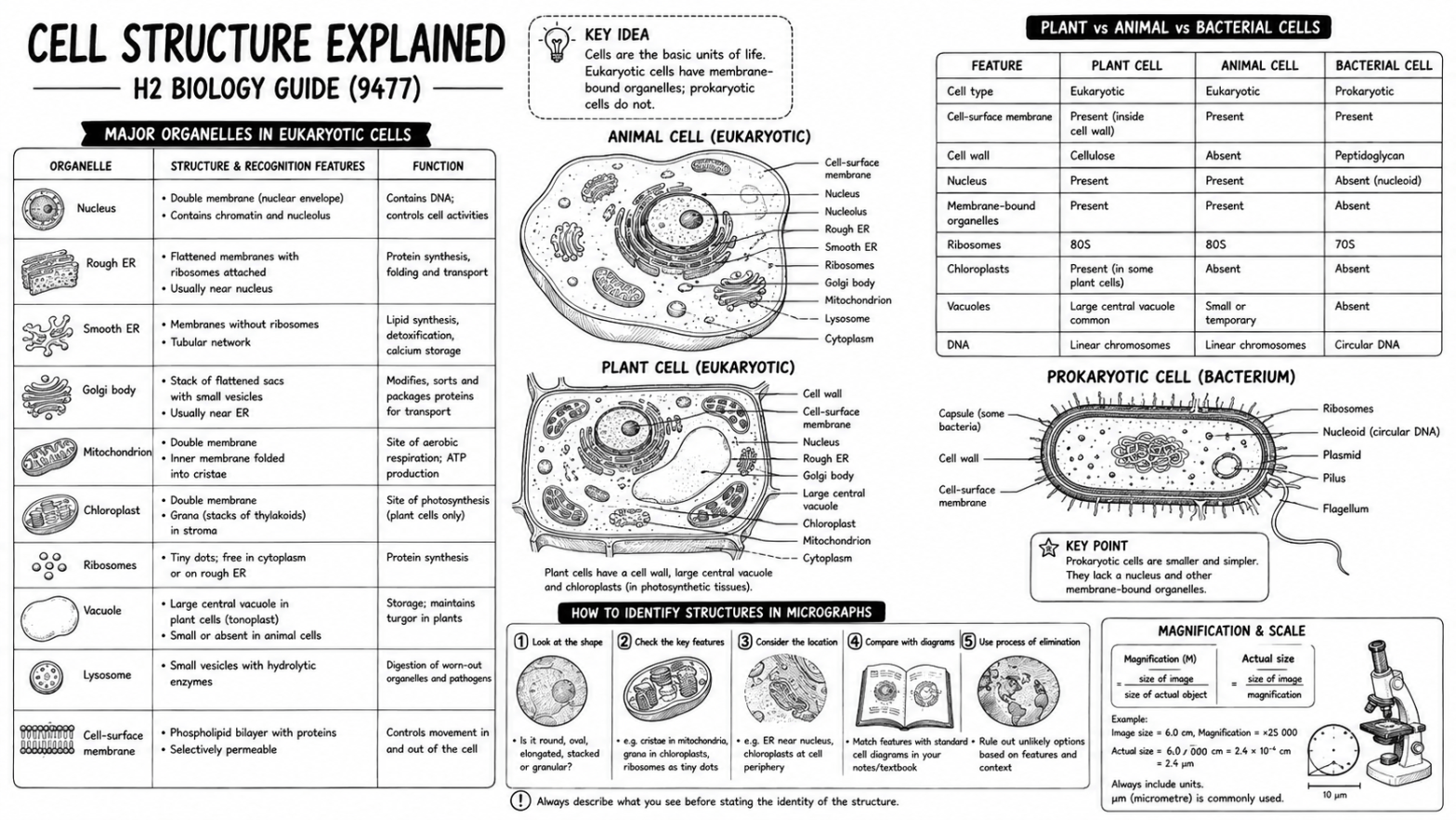
Quick answer: Eukaryotic cells (plant and animal) contain membrane-bound organelles that separate incompatible reactions and create specialised internal conditions; prokaryotic (bacterial) cells don’t. Plant cells have a cellulose cell wall, often a large central vacuole, and chloroplasts in photosynthetic tissue — but they still have a cell-surface membrane inside the wall, controlling exchange the sameContinue reading “Cell Structure Explained: H2 Biology Guide (9477)”
What the 2026 H2 Biology Syllabus Expects
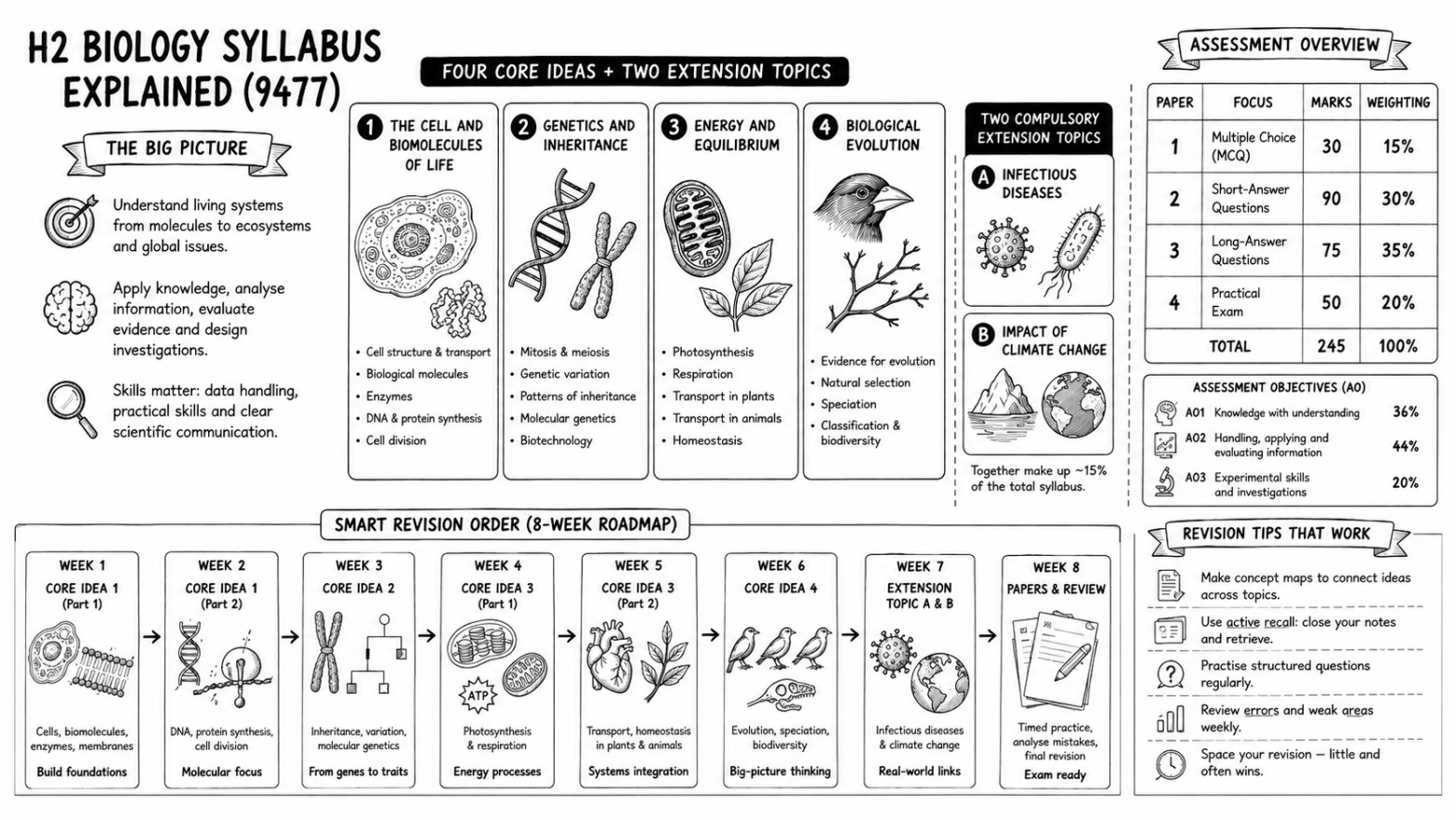
Quick answer: H2 Biology syllabus 9477 (first examined 2026) has four Core Ideas — The Cell and Biomolecules of Life, Genetics and Inheritance, Energy and Equilibrium, and Biological Evolution — plus two compulsory Extension Topics, Infectious Diseases and Impact of Climate Change, making up roughly 15% of the curriculum. Assessment objectives mean memorising content aloneContinue reading “What the 2026 H2 Biology Syllabus Expects”
Enzymes Explained: H2 Biology Guide (9477)

Quick answer: Enzymes are biological catalysts that lower a reaction’s activation energy without being used up. Temperature and pH affect activity by changing collision frequency and active-site shape; substrate and enzyme concentration affect it by changing how often active sites are occupied. Competitive inhibitors bind at the active site and can be outcompeted by moreContinue reading “Enzymes Explained: H2 Biology Guide (9477)”
O-Level Science Revision Checklist: Biology & Chemistry (2026)
Quick answer: An effective O-Level Science revision checklist has five parts: complete a full content review before intensive practice, organise revision by topic rather than randomly, practise a mix of question types, keep an error log and review mistakes by category, and revise Biology and Chemistry with different methods since they reward different skills. UseContinue reading “O-Level Science Revision Checklist: Biology & Chemistry (2026)”
Common Biology Exam Mistakes Singapore Students Make (and How to Fix Them)

Quick answer: Most marks lost in Biology exams aren’t from missing content — they’re from misreading command words, writing vague or general answers, and rushing past diagrams and data. Below are the seven mistakes that show up most often in O-Level and A-Level (H2) Biology scripts, each with a real example of what costs marks,Continue reading “Common Biology Exam Mistakes Singapore Students Make (and How to Fix Them)”
Biology vs Chemistry: Which Is Harder for O-Level Students? (2026)

Quick answer: Neither is objectively harder — they test different skills. O-Level Biology (syllabus 6093) demands more content coverage and precise written recall across a wide range of topics; O-Level Chemistry (syllabus 6092) demands fewer topics but deeper conceptual application, especially in calculations and unfamiliar scenarios. Which one feels harder usually comes down to whetherContinue reading “Biology vs Chemistry: Which Is Harder for O-Level Students? (2026)”
