
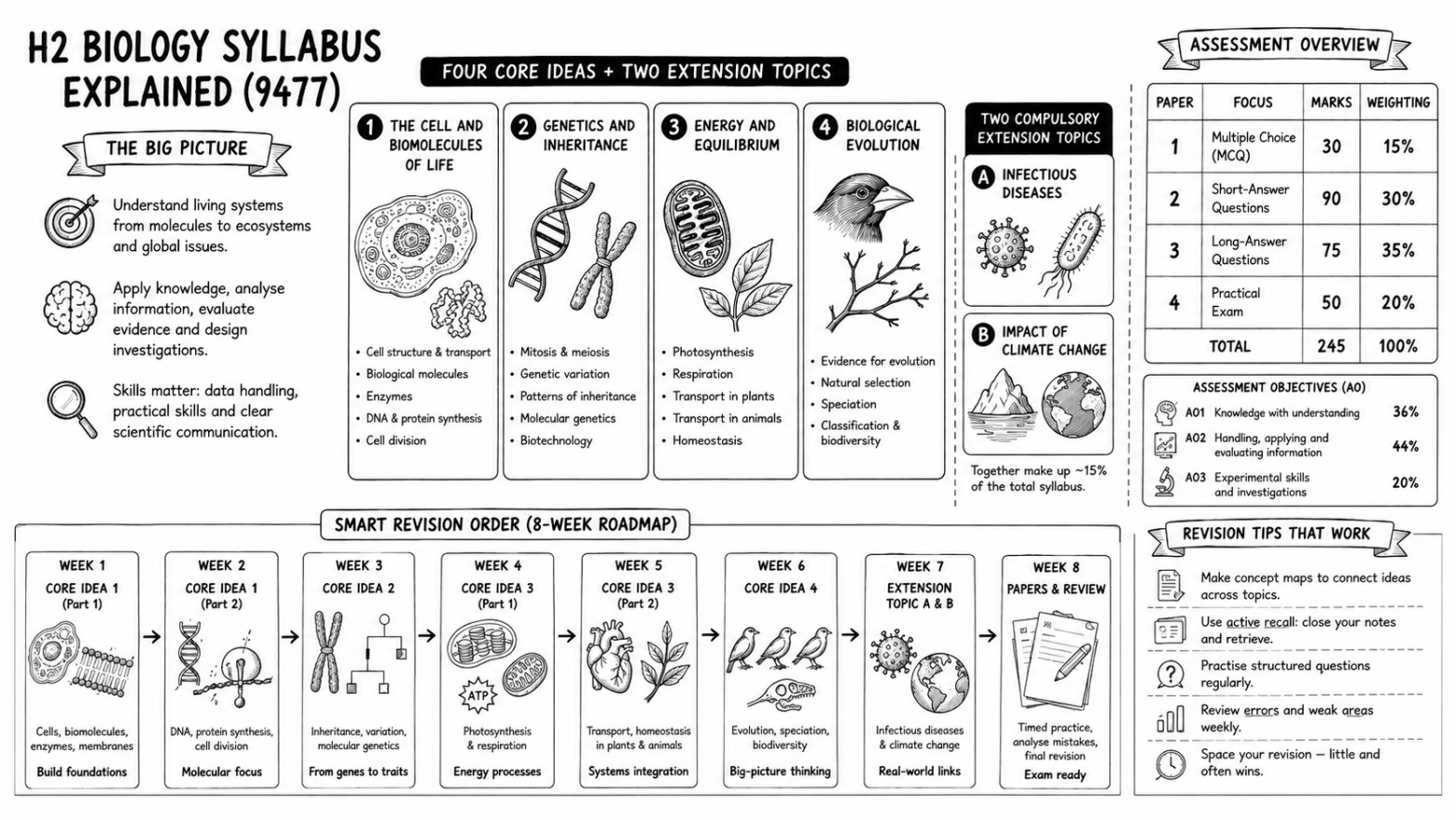
Quick answer: H2 Biology syllabus 9477 (first examined 2026) has four Core Ideas — The Cell and Biomolecules of Life, Genetics and Inheritance, Energy and Equilibrium, and Biological Evolution — plus two compulsory Extension Topics, Infectious Diseases and Impact of Climate Change, making up roughly 15% of the curriculum. Assessment objectives mean memorising content alone caps a student well below full marks: Knowledge with understanding is 36%, Handling/applying/evaluating information is 44%, and experimental skills are 20%. This guide breaks down every Core Idea, the official paper weightings, and a revision order that builds molecular foundations before integrated topics.
Strong H2 Biology notes do more than collect definitions — they organise molecular detail into connected explanations, show how evidence supports each conclusion, and make it easier to retrieve precise ideas under exam pressure. This guide follows the Singapore-Cambridge GCE A-Level H2 Biology syllabus 9477 for the first examination in 2026, mapping the four Core Ideas and two Extension Topics, explaining the most important links between them, and giving exam-focused strategies for Papers 1 to 4. This structured, connected approach is exactly what H2 Biology tuition at Pamela’s Place is built around — not re-teaching content in isolation, but building the cross-topic links that integrated exam questions actually reward.
Use this as a master map alongside your school notes — to decide what each topic is really asking, which diagrams and processes must be recalled accurately, and how to turn knowledge into a complete answer.
Table of Content
What the 2026 H2 Biology Syllabus Expects
The revised syllabus studies life mainly at cellular and molecular levels, then connects these mechanisms to organisms, populations, and real-world issues. O-Level Biology knowledge is treated as a foundation — or, for students coming through the Integrated Programme, IP Biology covers similar ground on a different timeline — so revision should move quickly from basic recall to explanation, application, and evaluation.
A useful way to read the syllabus is through its assessment objectives: Knowledge with understanding contributes 36% of the qualification, Handling/applying/evaluating information contributes 44%, and experimental skills contribute 20%. Memorising content is necessary, but it is not enough.
| Paper | Format | Marks | Weighting | What to prepare |
| Paper 1 | 30 multiple-choice questions, 1 hour | 30 | 15% | Fast recall, close reading, calculations, elimination of distractors |
| Paper 2 | Structured questions, 2 hours | 90 | 30% | Precise explanations, data-based questions, links across topics |
| Paper 3 | Long structured questions plus one free-response answer, 2 hours | 75 | 35% | Unfamiliar stimulus, analysis, evaluation, sustained scientific argument |
| Paper 4 | Practical assessment, 2 hours 30 minutes | 50 | 20% | Planning, manipulation, data presentation, analysis, evaluation |
Revision principle: spend at least as much time applying knowledge as learning it — data interpretation, unfamiliar contexts, and cross-topic reasoning are central parts of the assessment, not an advanced extra.
The Complete H2 Biology Syllabus Map
The Extension Topics make up about 15% of the curriculum, but shouldn’t be revised as isolated chapters. Infectious Diseases depends on cell structure, viral genetics, gene expression, and immunity. Impact of Climate Change depends on energy, selection, biodiversity, and population-level consequences.
| Syllabus area | Main content | Revision question |
| 1. The Cell and Biomolecules of Life | Cell structures, viruses, biomolecules, membranes, proteins, enzymes, stem cells | How does molecular structure make a biological function possible? |
| 2. Genetics and Inheritance | Nucleic acids, gene expression, genomes, mutation, cell cycles, cancer, inheritance | How is biological information stored, controlled, changed, and passed on? |
| 3. Energy and Equilibrium | Photosynthesis, respiration, cell signalling, blood-glucose regulation | How do cells transform energy and coordinate responses? |
| 4. Biological Evolution | Variation, natural selection, evidence, species, phylogeny, Hardy-Weinberg | How do allele frequencies and lineages change over time? |
| A. Infectious Diseases | Immunity, vaccination, viral disease, bacterial disease, antibiotics | How do pathogens spread, and how can biological knowledge control them? |
| B. Impact of Climate Change | Greenhouse gases, ecosystems, food supply, biodiversity, vector-borne disease | How does environmental change affect organisms and human systems? |
Core Idea 1: The Cell and Biomolecules of Life
This Core Idea establishes the language used throughout the course: structure leads to property, property enables interaction, interaction produces function. Build notes around that chain instead of memorising feature lists.
Cell theory, cell structures, and microscopy: know the cell theory and why viruses challenge simple definitions of life. Practise magnification and actual-size calculations (Magnification = image size ÷ actual size), and calibrate an eyepiece graticule only against a stage micrometer at the stated objective lens. In an image question, describe what’s visible before explaining what it suggests — a double membrane or internal folds may support an identification, but a label should never replace the evidence. (For the full organelle-by-organelle breakdown, prokaryote/eukaryote comparisons, and micrograph identification technique, see our Cell Structure Explained deep dive — this section covers only what’s needed for the syllabus map.)
Biomolecules and the cell-surface membrane: revise monomers of carbohydrates, lipids, and proteins with condensation, hydrolysis, and the bonds formed, plus structure-function explanations for starch, cellulose, glycogen, triglycerides, and phospholipids. For membranes, explain the fluid mosaic model, then compare simple diffusion, osmosis, facilitated diffusion, active transport, endocytosis, and exocytosis — stating whether each requires a membrane protein, uses metabolic energy, and moves with or against a gradient.
Proteins, enzymes, and inhibition: protein questions often need a sequence from amino-acid order to final function — revise primary through quaternary structure and the bonds that maintain each level. For enzymes, explain active-site specificity through lock-and-key and induced-fit, link temperature/pH/concentration to collision frequency or active-site shape, and distinguish competitive from non-competitive inhibition by binding site and the effect of added substrate. (For full worked rate calculations, inhibitor graphs, and practical investigation methods, see our Enzymes Explained deep dive.)
Stem cells: distinguish totipotent zygotic, pluripotent embryonic, and multipotent blood stem cells, connecting potency to the range of specialised cells each can produce.
Core Idea 1 check: can you move from a molecular or cellular feature to its consequence without skipping a step? This reasoning pattern underlies biomolecules, membranes, enzymes, and organelles alike.
Core Idea 2: Genetics and Inheritance
The largest content area, connecting directly to viruses, bacteria, cancer, evolution, and infectious disease. Revise it as an information system: storage in DNA, expression through RNA and proteins, regulation, variation, and inheritance.
DNA, RNA, and the central dogma: know DNA, mRNA, tRNA, and rRNA structure and roles. DNA replication covers complementary base pairing, semi-conservative replication, directionality, and the end-replication problem; gene expression covers transcription, pre-mRNA processing, and translation. A process answer should identify location, template, enzyme/machinery, direction of synthesis, and product — not a memorised paragraph that ignores the stage the question actually names.
Genome organisation and gene regulation: compare viral, prokaryotic, and eukaryotic genomes by nucleic-acid type, strandedness, linearity, and packing. Differential gene expression can be controlled at chromatin, transcriptional, post-transcriptional, translational, and post-translational levels — link each control point to a specific mechanism (DNA methylation to chromatin accessibility; promoters/enhancers/silencers to transcription rate; splicing to mature mRNA). In bacteria, revise the lac operon; in viruses, compare lytic and lysogenic cycles, influenza, and HIV reproduction.
Genetic variation, DNA analysis, and genomics: variation arises through mutation, bacterial gene transfer, viral antigenic drift/shift, meiosis, and random fertilisation — keep the source of variation separate from the process that acts on it. For 2026, focus on PCR, gel electrophoresis, Southern blotting, and nucleic-acid hybridisation: know the principle, procedure, purpose, and a relevant limitation of each.
Cell cycles, mutation, and cancer: revise the mitotic cycle and checkpoints against meiosis (crossing-over, independent assortment, random fertilisation). Distinguish gene mutation (substitution, addition, deletion, frameshift) from chromosomal aberration, linking a named example (sickle-cell anaemia, trisomy 21) to the relevant change. For cancer, link tumour-suppressor loss-of-function (p53) and proto-oncogene gain-of-function (ras) to uncontrolled division, with angiogenesis and metastasis explaining progression.
Inheritance and genetic problem-solving: practise dihybrid crosses with codominance, multiple alleles, sex linkage, autosomal linkage, and epistasis — the aim is deriving the outcome from the stated model, not memorising every ratio. Distinguish continuous from discontinuous variation, use a test cross to infer genotype, and apply a chi-squared test to decide whether observed-vs-expected differences are likely due to chance.
Core Idea 2 check: can you trace one DNA change through gene expression to a cellular effect, phenotype, or inheritance pattern? This cross-scale chain drives frequent application questions.
Core Idea 3: Energy and Equilibrium
Links energy transformation to communication and homeostasis. Photosynthesis stores energy in organic molecules, respiration transfers usable energy to ATP, and cell signalling coordinates responses across cells and tissues.
Photosynthesis: connect thylakoid membranes to light-dependent reactions and the stroma to the Calvin cycle. For light-dependent reactions, track light absorption, electron transfer, proton movement, chemiosmosis, and ATP/reduced NADP formation; for the Calvin cycle, organise into carbon-dioxide fixation, PGA reduction, and RuBP regeneration. Limiting-factor questions need interpretation — identify the restricting factor in the stated range, not a fixed rule.
Respiration: learn glycolysis, the link reaction, the Krebs cycle, and oxidative phosphorylation as connected stages, with location, main inputs/products, and purpose for each — detailed intermediate names aren’t required by the 2026 syllabus. In anaerobic conditions, yeast forms ethanol and mammalian muscle forms lactate; the key significance is NAD regeneration so glycolysis can continue.
Cell signalling and blood-glucose regulation: organise signalling into reception, transduction, and response — ligand binding, conformational change, intracellular pathway activation, cellular response. Use insulin and glucagon as contrasting examples through tyrosine-kinase and G-protein-linked receptors; the syllabus doesn’t require every named intermediate, just receptor activation, downstream signalling, and the physiological outcome.
Core Idea 3 check: can you distinguish energy transfer from matter transfer? ATP, reduced coenzymes, electrons, protons, and carbon compounds have related but different roles.
Core Idea 4: Biological Evolution
Rewards precise population-level language. Individuals differ in phenotype and survival, but populations evolve when allele frequencies change over generations.
Variation arises through mutation, meiosis, and sexual reproduction; environmental factors create selection pressures; individuals with advantageous heritable traits may leave more offspring, so relevant alleles become more common — extend this without implying organisms change because they “need to.” Revise evidence from molecular homologies, anatomical homologies, fossils, and biogeography, and use classification/phylogeny to infer relationships from shared characteristics and sequence comparisons.
The biological species concept centres on interbreeding and fertile offspring, with limitations for asexual organisms, fossils, and separated populations — speciation requires reproductive isolation via geographical, behavioural, or physiological barriers.
Hardy-Weinberg: p² + 2pq + q² = 1, with p + q = 1. Define p and q before calculating, then return to context afterward and assess whether the model’s assumptions (large, randomly mating population, no selection/mutation/migration) are plausible.
| Evolution task | Reasoning chain |
| Explain natural selection | Existing heritable variation → different reproductive success → changed allele frequencies |
| Explain speciation | Reduced gene flow + divergent selection/genetic change → reproductive isolation |
| Interpret a phylogeny | Identify shared ancestry from branching pattern, then support with molecular or other evidence |
| Apply Hardy-Weinberg | Define alleles, convert phenotype data carefully, calculate frequencies, evaluate assumptions |
Extension Topic A: Infectious Diseases
Brings together pathogens, host responses, and public-health decisions. Compare innate defence with adaptive immunity, then active/passive and natural/artificial acquisition.
For an adaptive response, track antigen recognition, presentation, clonal selection, lymphocyte proliferation, effector-cell action, and memory-cell formation — link IgG antibody structure to antigen binding and function, with somatic recombination, hypermutation, and class switching explaining antibody diversity.
Vaccination exposes the immune system to antigen without full disease, promoting memory-cell formation and a faster secondary response; at population level, sufficient coverage can interrupt transmission. Know how influenza and HIV disrupt different host tissues/immune functions, and use Mycobacterium tuberculosis for bacterial transmission — penicillin interferes with cell-wall formation, so it doesn’t treat viral disease. The basic reproduction number R0 indicates transmissibility as a model with assumptions, not a fixed property.
Extension Topic B: Impact of Climate Change on Animals and Plants
Start with causes — CO₂ and methane accumulating through fossil-fuel use, forest clearing, and some food-production choices — then follow the mechanism through warming to consequences: melting ice, sea-level rise, extreme weather, freshwater stress, and pressure on coral reefs, seagrass, and mangrove ecosystems (mangroves both mitigate and help species adapt).
Carbon-footprint comparisons should state the boundary used and avoid claiming any energy source has zero cost. Climate stress can shift habitats, food chains, and species distributions; increased temperature can also affect insect-vector metabolism and life cycles (e.g. Aedes aegypti), altering dengue or malaria’s geographical spread.
Extension-topic check: build explanations from mechanism to consequence — environmental change → cellular/physiological response → effect on survival/reproduction → population change → wider ecosystem or societal impact.
Paper 4 Practical Skills
Practical revision should be continuous, since Paper 4 contributes 20% of the qualification. The four assessed skill areas are Planning; Manipulation, Measurement and Observation; Presentation of Data and Observations; Analysis, Conclusions and Evaluation.
Planning: state an independent variable with a suitable range, a measurable dependent variable, controlled variables with named values, repeats with a mean, and a safe method with quantities, timings, and a clear end point.
Recording, graphing, and evaluating: tables need headings with units and consistent precision; graphs need appropriate scale, labelled axes, and accurately plotted points. A strong evaluation identifies a specific limitation, states its effect, and proposes a targeted improvement — “human error” or “use better equipment” don’t demonstrate enough reasoning.
| Weak evaluation | Stronger evaluation |
| “The temperature changed.” | “The reaction mixture may not have reached the set temperature, so rate comparisons are invalid. Pre-equilibrate each tube in a thermostatically controlled water bath.” |
| “There were too few repeats.” | “Random variation may distort the mean. Repeat each treatment at least three times, identify justified anomalies, and calculate a mean.” |
| “The end point was subjective.” | “Judging colour by eye creates observer variation. Use a colorimeter and define the absorbance threshold used as the end point.” |
Mathematics and data handling: means, ratios, percentages, rates, graph interpretation, standard deviation, t-tests, chi-squared tests, and Hardy-Weinberg. Equations and statistical tables are provided where specified, but you must know how to use the results — a complete statistical conclusion states the null hypothesis, significance level, comparison with the critical value, decision, and biological meaning. Don’t write “significant” when you only mean “large.”
Recommended H2 Biology Revision Order
- Cells, microscopy, and biomolecules — image interpretation, magnification, membrane questions.
- Proteins, enzymes, and stem cells — structure-function explanations, rate graphs.
- DNA, gene expression, and genome organisation — process recall plus unfamiliar molecular data.
- Mutation, cell cycles, cancer, and inheritance — genetic problems, chi-squared, cross-topic chains.
- Photosynthesis, respiration, and signalling — energy diagrams, rate data, homeostasis questions.
- Evolution and Hardy-Weinberg — selection explanations, phylogenies, calculations.
- Infectious disease and climate change — evidence-based evaluation, integrated responses.
- Practical skills and full-paper practice — timed papers, error log, targeted repair.
Adapt this to your school sequence and current weaknesses, but keep practical work and data handling active every week rather than leaving Paper 4 to the end. For the active-recall techniques and timed-practice routines that make this order actually work — not just what to revise, but how — see our H2 Biology Revision Guide.
A Cross-Topic Link Page Worth Building
| Link | Topics connected | Typical question angle |
| Protein structure and mutation | Biomolecules, genetics, cancer | How a DNA change alters protein function and phenotype |
| Membranes and signalling | Cell membranes, enzymes, homeostasis | How receptors and cascades create a specific response |
| Variation and selection | Meiosis, mutation, infectious disease, evolution | How selection changes a population over time |
| Energy and climate | Photosynthesis, respiration, climate change | How carbon and energy processes scale from cells to ecosystems |
| Viruses and immunity | Viral genetics, gene expression, infectious disease | How a pathogen reproduces and how the host responds |
Exam Strategy for Each Paper
Paper 1: average two minutes per question, but move on if a calculation or unfamiliar context is taking too long — eliminate choices with precise biological statements, then return to flagged questions.
Paper 2: let the command word decide the answer’s form — describe gives the pattern, explain gives the mechanism, suggest applies known biology to a new context. In data questions, quote relevant values with units before giving a biological reason.
Paper 3: read the stimulus for usable evidence rather than trying to recognise a memorised topic immediately. For the free-response section, spend a few minutes planning a logical sequence with linked points, accurate examples, and a conclusion that answers the question.
Paper 4: follow the required precision, unit, and recording convention throughout. If a result is anomalous, record it honestly and use evidence to decide whether to exclude it from a mean.
Printable H2 Biology Revision Checklist
Tick an item only when you can complete it without notes and apply it to a new context.
Core Idea 1:
Recognise cell structures in diagrams/micrographs and link feature to function
Compare eukaryotic, prokaryotic, and viral structure
Calculate magnification/actual size with correct units
Relate biomolecule structure to function
Compare all syllabus membrane-transport mechanisms
Explain enzyme action, inhibition, and rate graphs
Distinguish totipotent, pluripotent, and multipotent stem cells
Core Idea 2:
Explain DNA replication, transcription, RNA processing, translation
Compare viral, prokaryotic, and eukaryotic genome organisation
Explain gene-expression control at each level
Outline viral cycles and bacterial gene transfer
Interpret DNA-analysis/genomic evidence
Connect mutation, cell-cycle control, and cancer
Solve inheritance problems with chi-squared
Core Ideas 3 & 4:
Track location/inputs/outputs/purpose through photosynthesis and respiration
Explain chemiosmosis without confusing proton and electron movement
Explain signalling reception, transduction, amplification, response
Apply insulin/glucagon signalling to blood-glucose regulation
Explain natural selection with allele-frequency language
Evaluate evolution/species-concept/phylogeny evidence
Complete Hardy-Weinberg calculations and state assumptions
Extension topics, practical, and data:
Compare innate and adaptive immunity, explain vaccination
Link greenhouse-gas accumulation to organismal/ecosystem effects
Explain climate change’s effect on biodiversity, food supply, vector-borne disease
Plan a valid investigation with controls, repeats, safety
Construct correctly-labelled tables and graphs □ Evaluate via limitation → effect → specific improvement
 Use standard deviation, t-tests, chi-squared in context
H2 Biology Syllabus FAQs
1. How many topics are in the H2 Biology syllabus?
Four Core Ideas, studied by every candidate, plus two compulsory Extension Topics making up roughly 15% of the curriculum.
- Core Ideas: Cell and Biomolecules of Life, Genetics and Inheritance, Energy and Equilibrium, Biological Evolution.
- Extension Topics: Infectious Diseases, Impact of Climate Change.
2. Which H2 Biology topic should I revise first?
Begin with cells, biomolecules, and proteins if your foundation is weak, since these support genetics, energy, and immunity; if your foundation is secure, start with whichever topic produces the most errors in timed work.
- The recommended order above follows this dependency logic across all eight weeks.
3. Is H2 Biology 9477 different from the previous syllabus?
Yes — 9477 is the revised course first examined in 2026, replacing 9744, reorganised around four Core Ideas and adding quantitative work like Hardy-Weinberg calculations.
- Use current 9477 learning outcomes when choosing notes or practice material, since older resources may reflect different content boundaries.
4. How much of the H2 Biology exam is application rather than recall?
Handling, applying, and evaluating information contributes 44% of the assessment, with a further 20% from experimental skills — content recall alone caps a student at 36%.
- This is why data interpretation and unfamiliar contexts need as much practice time as content review.
5. Are H2 Biology notes enough on their own for an A grade?
Notes provide the knowledge base, but high grades depend on retrieval, application, data handling, and precise communication — pair every section with closed-book recall and exam questions.
- See our H2 Biology Revision Guide for the active-recall and timed-practice methods that convert notes into exam-ready recall.
6. How often should I practise Paper 4 skills?
Include a practical or data-handling task every week, rotating planning, microscopy, data presentation, statistics, and evaluation so none of the skills go stale.
- Leaving Paper 4 preparation to the final weeks is one of the most common, avoidable revision mistakes.
7. Do the same mistakes that cost marks at O-Level carry over to H2 Biology?
Yes, and they tend to cost more — command-word misreading, vague terminology, and weak linking between ideas all resurface at H2, just applied to more integrated content where a single gap can affect several marks at once rather than one.
- Our Common Biology Exam Mistakes guide breaks down these patterns in detail, with examples at both O-Level and H2 depth. (Proposed slug — not yet published; confirm the real URL once live.)
8. Is the jump from O-Level Biology to H2 Biology bigger than other subjects?
It’s often the biggest conceptual jump across the sciences, since H2 Biology moves into molecular and cellular detail — gene expression, cell signalling, immunology — that O-Level only lightly touches, rather than simply extending familiar O-Level topics further.
- Students who relied on memorisation over genuine conceptual connection at O-Level tend to find this transition hardest — our O-Level Biology Tips to Score A1 guide covers building the kind of understanding that actually transfers to JC.
Official Syllabus Reference
Singapore Examinations and Assessment Board: GCE A-Level H2 Biology syllabus 9477 for 2026.
Explore More Learning Resources
Get Structured H2 Biology Support
If your notes feel complete but exam answers remain inconsistent, the problem is often organisation rather than effort. At Pamela’s Place, H2 Biology revision is organised around syllabus coverage, active-recall routines, topic-by-topic question practice, and focused feedback — in small Omakase groups capped at 7 students. The aim is to make every study session lead to a clearer explanation or a more reliable exam skill, not just more content covered.

One thought on “What the 2026 H2 Biology Syllabus Expects”