

Quick answer: The 2026 Singapore-Cambridge GCE O-Level Pure Chemistry syllabus (6092) has 12 topics in three sections and is assessed through three compulsory papers: Paper 1 (40 multiple-choice questions, 30%), Paper 2 (structured and free-response, 80 marks, 50%) and Paper 3 (practical, 40 marks, 20%). Chemistry within Combined Science (5086 and 5088) uses the sameContinue reading “O Level Chemistry Syllabus 2026 Explained”
Author Archives: Pamela's Place
Photosynthesis Explained: O-Level Biology Guide (6093)

Quick answer: Photosynthesis is the process by which green plants use light energy, absorbed by chlorophyll, to convert carbon dioxide and water into glucose and oxygen. At O-Level, you need to state the word and chemical equations, explain how leaf structure and transport tissues support the process, identify and explain the three limiting factors (lightContinue reading “Photosynthesis Explained: O-Level Biology Guide (6093)”
DNA Replication Explained: H2 Biology Guide (9477)
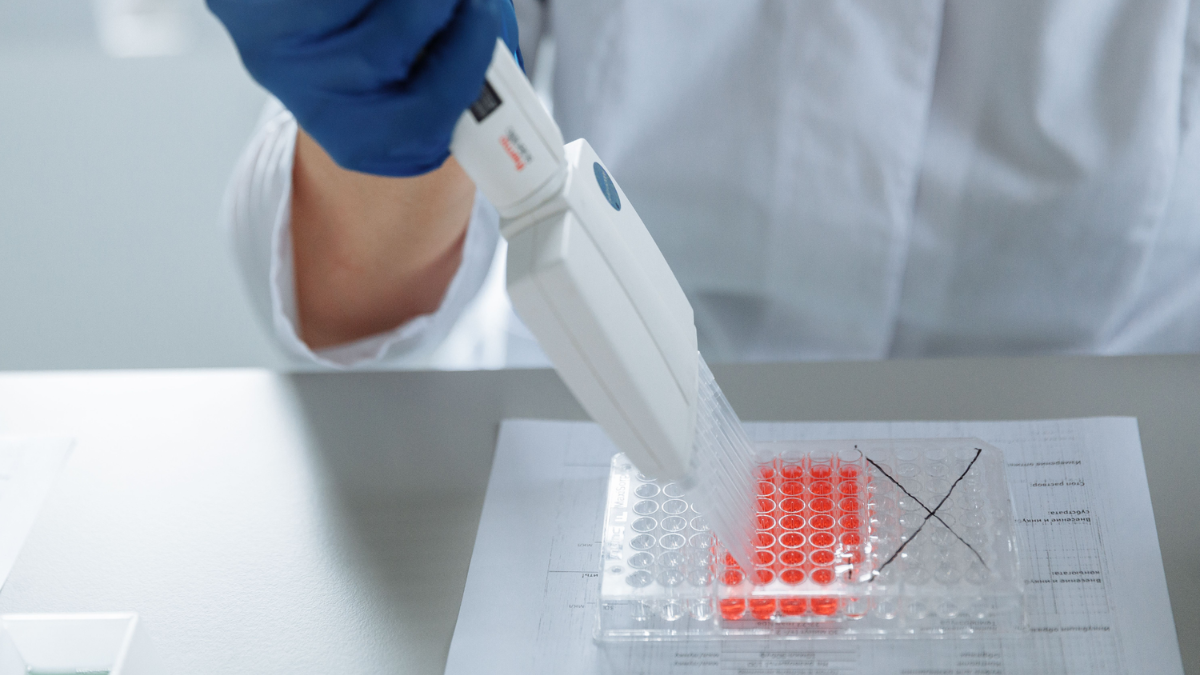
Quick answer: DNA replication is semi-conservative — each new DNA molecule contains one original strand and one newly synthesised strand. Helicase unwinds the double helix by breaking hydrogen bonds between base pairs; primase lays down short RNA primers; DNA polymerase extends new strands, but only in the 5’→3′ direction, which is why one strand (leading)Continue reading “DNA Replication Explained: H2 Biology Guide (9477)”
Transition Metals Explained: H2 Chemistry Guide (9476)

Quick answer: A transition element is a d-block element that forms at least one stable ion with an incomplete d subshell — which is why zinc (Zn²⁺ = [Ar]3d¹⁰) doesn’t qualify despite being in the d-block. Chromium ([Ar]3d⁵4s¹) and copper ([Ar]3d¹⁰4s¹) are the two classic exceptions to the expected filling pattern. Transition metals show variableContinue reading “Transition Metals Explained: H2 Chemistry Guide (9476)”
Atomic Radius Explained: H2 Chemistry Guide (9476)

Quick answer: Atomic radius decreases across a period (rising nuclear charge, shielding barely changes) and increases down a group (extra occupied shells outweigh the higher nuclear charge). Sodium’s atomic radius is 0.157 nm versus chlorine’s 0.099 nm across Period 3; magnesium’s is 0.160 nm versus barium’s 0.217 nm down Group 2. Ionic radius follows theContinue reading “Atomic Radius Explained: H2 Chemistry Guide (9476)”
Shielding Effect Explained: H2 Chemistry Guide (9476)
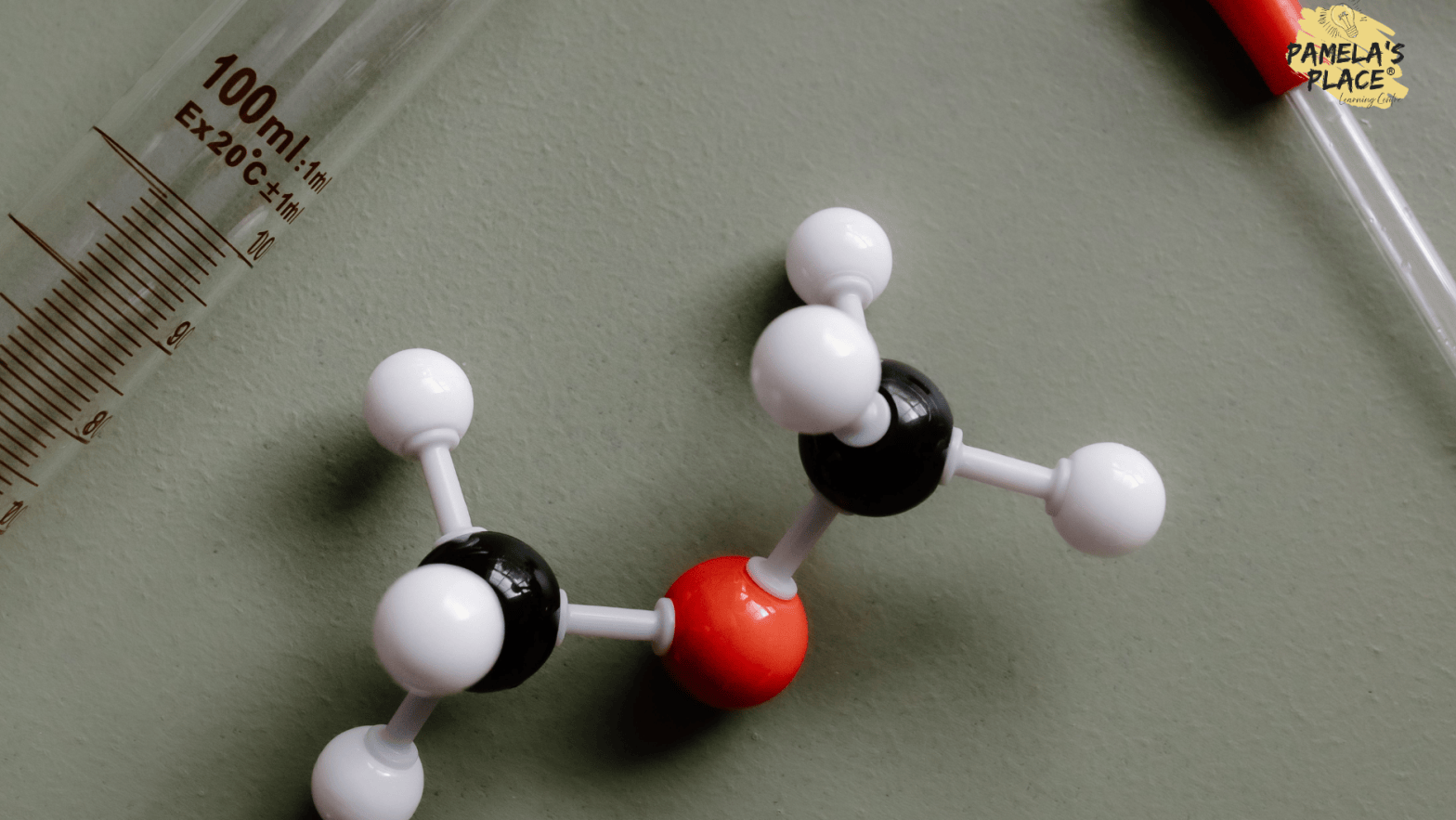
Quick answer: The shielding effect is the reduction in nuclear attraction felt by an outer electron because inner-shell electrons repel it — the nucleus’s charge hasn’t weakened, the outer electron simply doesn’t experience all of it. Shielding barely changes across a period, since added electrons enter the same principal shell, but increases substantially down aContinue reading “Shielding Effect Explained: H2 Chemistry Guide (9476)”
Cell Structure Explained: H2 Biology Guide (9477)
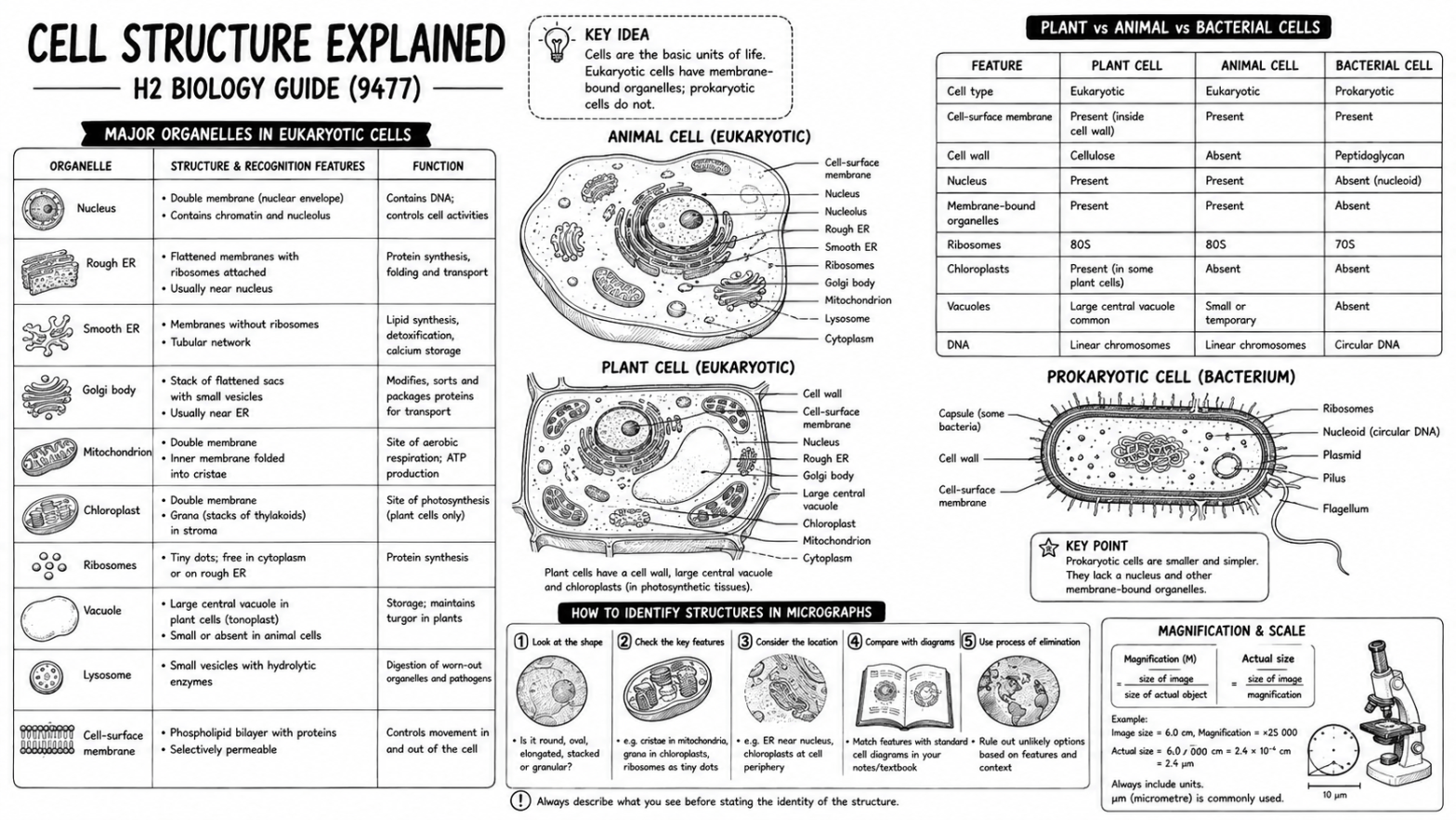
Quick answer: Eukaryotic cells (plant and animal) contain membrane-bound organelles that separate incompatible reactions and create specialised internal conditions; prokaryotic (bacterial) cells don’t. Plant cells have a cellulose cell wall, often a large central vacuole, and chloroplasts in photosynthetic tissue — but they still have a cell-surface membrane inside the wall, controlling exchange the sameContinue reading “Cell Structure Explained: H2 Biology Guide (9477)”
What the 2026 H2 Biology Syllabus Expects
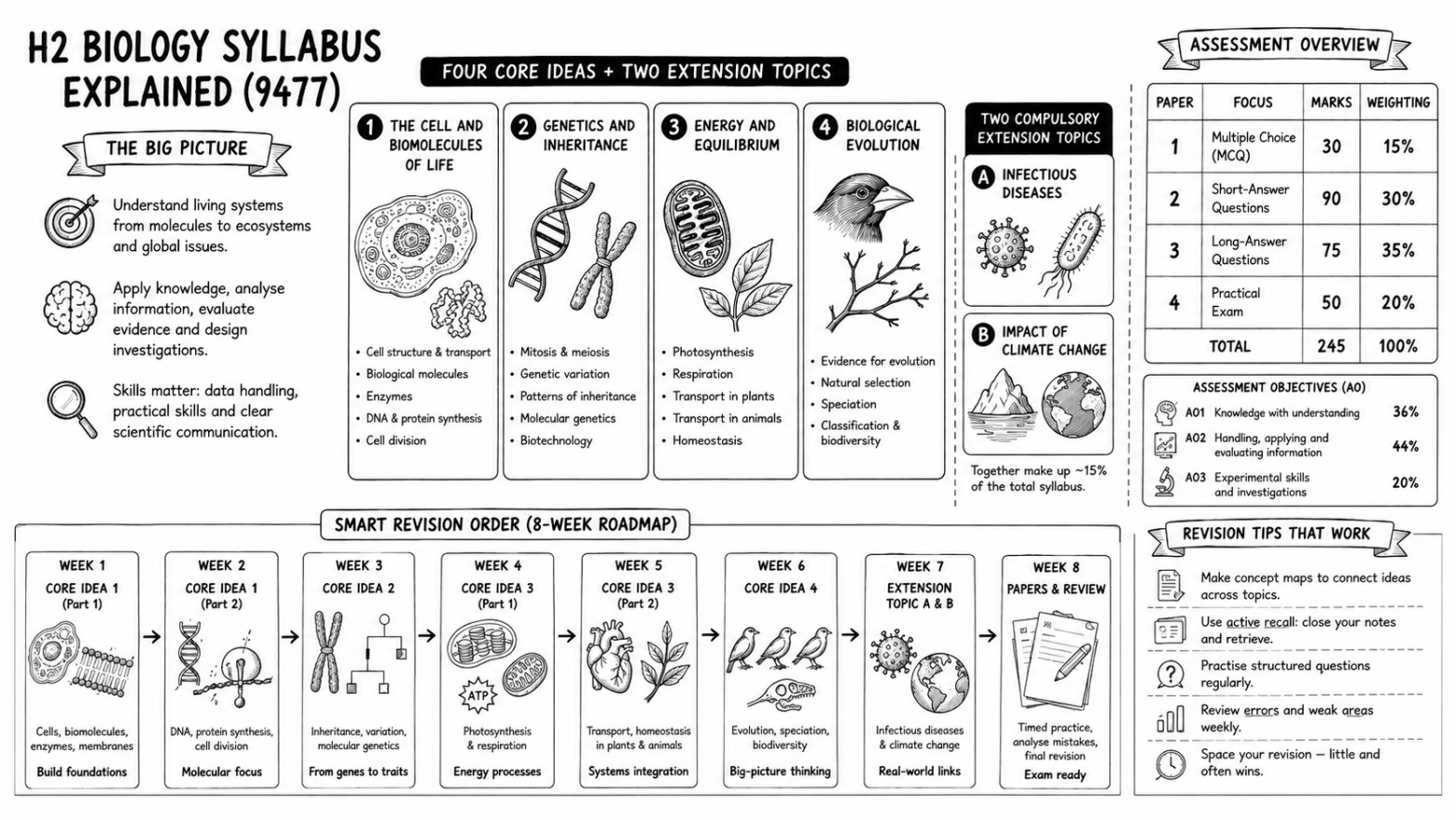
Quick answer: H2 Biology syllabus 9477 (first examined 2026) has four Core Ideas — The Cell and Biomolecules of Life, Genetics and Inheritance, Energy and Equilibrium, and Biological Evolution — plus two compulsory Extension Topics, Infectious Diseases and Impact of Climate Change, making up roughly 15% of the curriculum. Assessment objectives mean memorising content aloneContinue reading “What the 2026 H2 Biology Syllabus Expects”
Enzymes Explained: H2 Biology Guide (9477)

Quick answer: Enzymes are biological catalysts that lower a reaction’s activation energy without being used up. Temperature and pH affect activity by changing collision frequency and active-site shape; substrate and enzyme concentration affect it by changing how often active sites are occupied. Competitive inhibitors bind at the active site and can be outcompeted by moreContinue reading “Enzymes Explained: H2 Biology Guide (9477)”
Effective Nuclear Charge: The H2 Chemistry Exam-Answering Framework (9476)

Quick answer: Most students who lose marks on “explain the trend” questions already understand effective nuclear charge — the theory isn’t the problem. The problem is structure: naming a factor without connecting it to attraction, or listing every factor instead of the one that’s actually decisive for that specific comparison. This guide gives a repeatableContinue reading “Effective Nuclear Charge: The H2 Chemistry Exam-Answering Framework (9476)”
