
Quick answer: Enzymes are biological catalysts that lower a reaction’s activation energy without being used up. Temperature and pH affect activity by changing collision frequency and active-site shape; substrate and enzyme concentration affect it by changing how often active sites are occupied. Competitive inhibitors bind at the active site and can be outcompeted by moreContinue reading “Enzymes Explained: H2 Biology Guide (9477)”
Category Archives: Tuition Singapore
Effective Nuclear Charge: The H2 Chemistry Exam-Answering Framework (9476)

Quick answer: Most students who lose marks on “explain the trend” questions already understand effective nuclear charge — the theory isn’t the problem. The problem is structure: naming a factor without connecting it to attraction, or listing every factor instead of the one that’s actually decisive for that specific comparison. This guide gives a repeatableContinue reading “Effective Nuclear Charge: The H2 Chemistry Exam-Answering Framework (9476)”
O-Level Chemistry QA Table Explained: Complete Guide (6092)
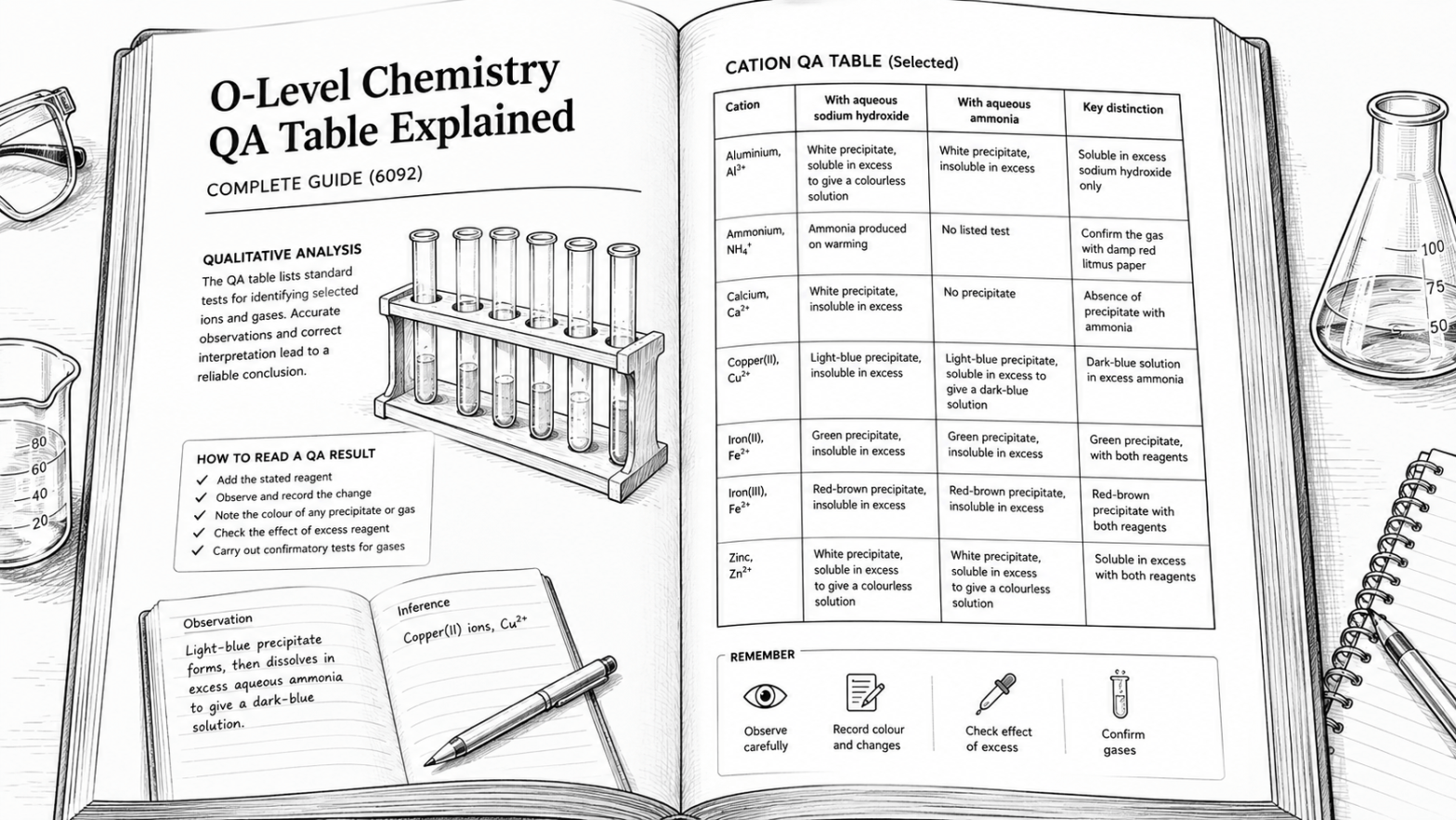
Quick answer: The O-Level Chemistry QA table covers standard tests for 7 aqueous cations, 5 anions, and 6 gases, printed as part of Paper 3. The table alone isn’t enough — three cations (Al³⁺, Ca²⁺, Zn²⁺) all give a white precipitate with sodium hydroxide, so distinguishing them requires comparing behaviour in excess reagent and testingContinue reading “O-Level Chemistry QA Table Explained: Complete Guide (6092)”
Ionisation Energy Explained: H2 Chemistry Guide (9476)
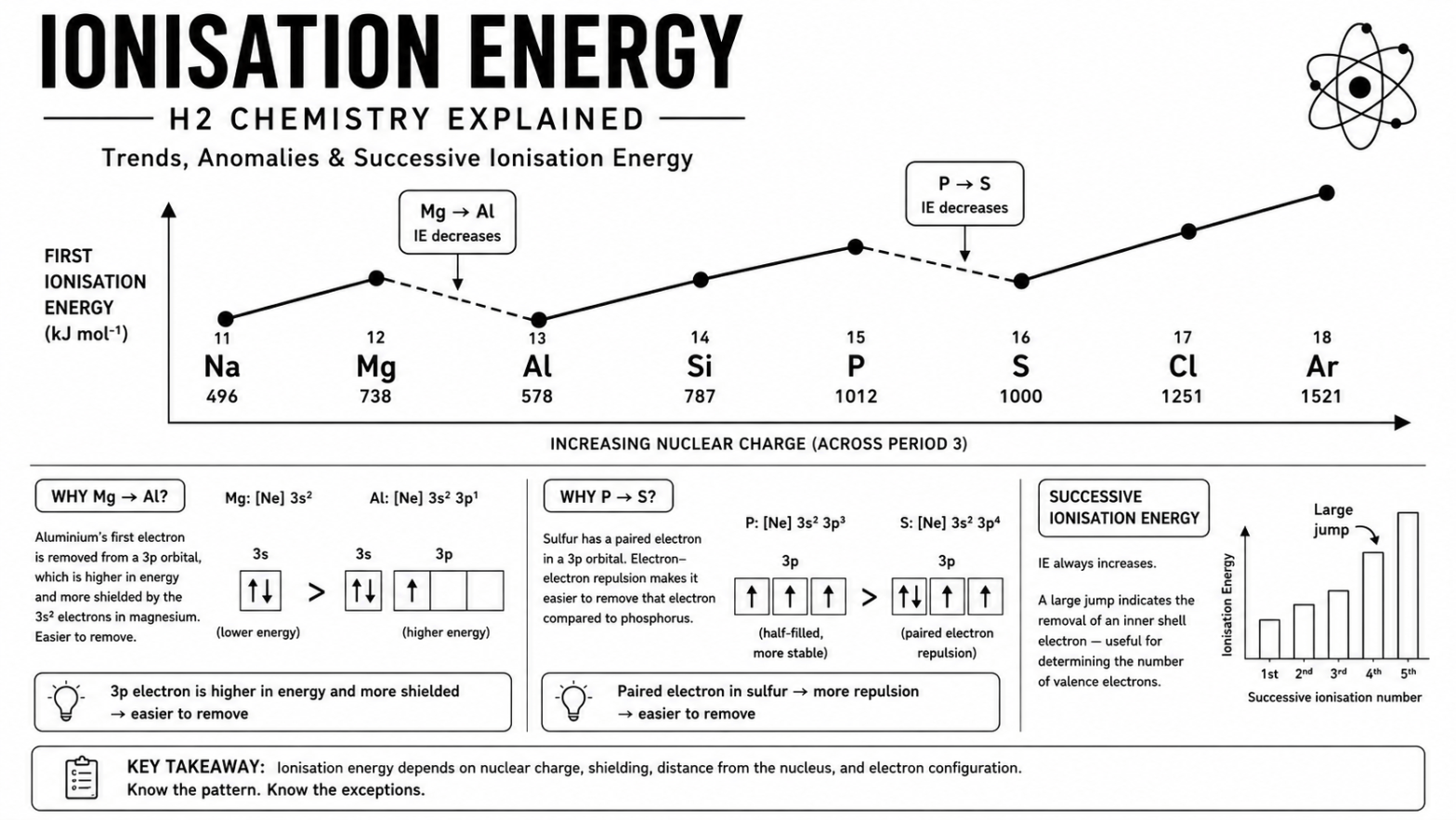
Quick answer: Ionisation energy is the energy needed to remove an electron from a gaseous atom or ion. First ionisation energy generally increases across a period (rising nuclear charge, similar shielding) and decreases down a group (electron further from the nucleus, more shielding). Two exceptions in Period 3 — aluminium being lower than magnesium, andContinue reading “Ionisation Energy Explained: H2 Chemistry Guide (9476)”
H2 Chemistry Syllabus Explained: Complete Topic Guide (9476)
Quick answer: The H2 Chemistry syllabus (9476, first examined 2026) has 13 numbered topics organised around three Core Ideas — Matter, Structure and Properties, and Transformation — plus Extension Topics covering Organic Chemistry, Electrochemistry, and Transition Elements. Topics aren’t isolated: atomic structure supports bonding, bonding explains properties, energetics connects to equilibrium, and organic reactions drawContinue reading “H2 Chemistry Syllabus Explained: Complete Topic Guide (9476)”
H2 Chemistry Data Booklet Explained: The Complete 2026 Guide (Syllabus 9476 & 9729)
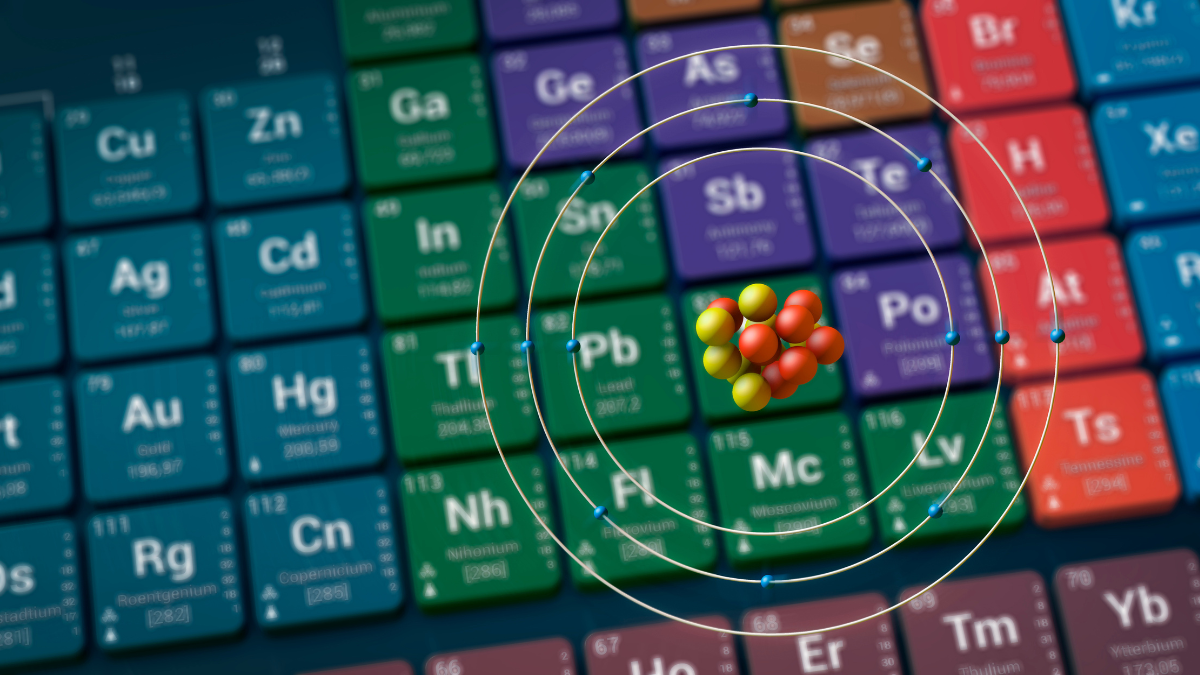
Quick answer: The H2 Chemistry Data Booklet is the official reference document issued in the theory papers for Singapore’s A-Level Chemistry (syllabuses 9476 and, for 2026, the outgoing 9729). It supplies constants, tables, and the Periodic Table — but not the formulas or methods needed to use them, which students must still know. This guideContinue reading “H2 Chemistry Data Booklet Explained: The Complete 2026 Guide (Syllabus 9476 & 9729)”
Common Biology Exam Mistakes Singapore Students Make (and How to Fix Them)

Quick answer: Most marks lost in Biology exams aren’t from missing content — they’re from misreading command words, writing vague or general answers, and rushing past diagrams and data. Below are the seven mistakes that show up most often in O-Level and A-Level (H2) Biology scripts, each with a real example of what costs marks,Continue reading “Common Biology Exam Mistakes Singapore Students Make (and How to Fix Them)”
Biology vs Chemistry: Which Is Harder for O-Level Students? (2026)

Quick answer: Neither is objectively harder — they test different skills. O-Level Biology (syllabus 6093) demands more content coverage and precise written recall across a wide range of topics; O-Level Chemistry (syllabus 6092) demands fewer topics but deeper conceptual application, especially in calculations and unfamiliar scenarios. Which one feels harder usually comes down to whetherContinue reading “Biology vs Chemistry: Which Is Harder for O-Level Students? (2026)”
Small Group Tuition in Singapore: How Many Students, Really?

Almost every tuition centre in Singapore advertises “small group” classes. Almost none of them mean the same thing by it. One centre’s “small group” is 4 students. Another’s is 10. Some large lecture-style operations describe classes of 15 to 20 as “small group” simply because it’s smaller than their biggest room. For a parent comparingContinue reading “Small Group Tuition in Singapore: How Many Students, Really?”
IP Chemistry Syllabus Singapore: Year 3 & Year 4 Guide

One of the most common questions parents have when their child enters the Integrated Programme isn’t “does my child need tuition” — it’s simpler than that: what exactly does IP Chemistry cover, and when? Unlike O-Level Chemistry, there’s no single MOE-published IP Chemistry syllabus document that every school follows identically. Each IP school — HwaContinue reading “IP Chemistry Syllabus Singapore: Year 3 & Year 4 Guide”
