
Quick answer: The 2026 Singapore-Cambridge GCE O-Level Pure Chemistry syllabus (6092) has 12 topics in three sections and is assessed through three compulsory papers: Paper 1 (40 multiple-choice questions, 30%), Paper 2 (structured and free-response, 80 marks, 50%) and Paper 3 (practical, 40 marks, 20%). Chemistry within Combined Science (5086 and 5088) uses the same 12 topic headings. Roughly 55% of theory marks reward handling information and solving problems, and only about 15% are straight recall, so application matters more than memorisation. From 2027 the O-Level becomes the Singapore-Cambridge Secondary Education Certificate (SEC), with G3 Chemistry coded K324 and the same 12 headings.
The 2026 O-Level Chemistry syllabus is published through the Singapore Examinations and Assessment Board (SEAB) within the Singapore-Cambridge system. Pure Chemistry is syllabus 6092, while Chemistry is also offered inside Combined Science under 5086 (Physics, Chemistry) and 5088 (Chemistry, Biology). This guide maps all 12 topics, explains how the papers are weighted, and shows how to turn the syllabus into a revision plan — the same approach we use in O-Level Chemistry tuition at Pamela’s Place.
Table of Contents
2026 O-Level Chemistry Syllabus at a Glance
For 2026, students should use the official syllabus for their own subject code. Pure Chemistry and Combined Science are assessed as different qualifications, even though their chemistry sections share the same 12 topic headings.
| Route | 2026 code | What it is |
| Pure Chemistry | 6092 | Standalone Chemistry subject |
| Combined Science (Physics, Chemistry) | 5086 | Chemistry plus Physics |
| Combined Science (Chemistry, Biology) | 5088 | Chemistry plus Biology |
| 2027 SEC G3 Chemistry | K324 | Reference code: 6092 |
Combined Science (Physics, Biology) is 5087 — it has no chemistry component, so it doesn’t appear in this guide.
Struggling With Chemistry?
Everything you need to score higher in O Level & A Level Chemistry — from exam tips to study strategies. Speak to Us · Reserve an Exclusive Slot
How the 12 Topics Are Organised
The 2026 Pure Chemistry syllabus is organised into three broad sections, and the official syllabus lists 12 chemistry topics across them. The Combined Science chemistry section uses the same 12 topic headings.
| Section | Topics | What to note |
| I. Matter — Structures and Properties | 1. Experimental Chemistry 2. The Particulate Nature of Matter 3. Chemical Bonding and Structure | The particle model and practical foundation used everywhere else. Examinable in both 6092 and the chemistry section of 5086/5088. |
| II. Chemical Reactions | 4. Chemical Calculations 5. Acid-Base Chemistry 6. Qualitative Analysis 7. Redox Chemistry 8. Patterns in the Periodic Table 9. Chemical Energetics 10. Rate of Reactions | The largest section: seven of the 12 topics. The same seven headings appear in 6092 and 5086/5088, and the 2027 K324 syllabus keeps them. |
| III. Chemistry in a Sustainable World | 11. Organic Chemistry 12. Maintaining Air Quality | Applies chemistry to fuels, materials and pollution. Both headings carry into the 2027 G3 syllabus. |
Seven of 12 topics sit in Section II, so most of the syllabus is about what happens when substances react — which is why calculations, redox and rates carry so much weight across papers.
O-Level Chemistry Topic Map
Use this table to decide where to start. Difficulty and revision stage are our teaching judgement, not SEAB classifications — they reflect where students most often lose marks and which topics unlock others.
| Topic | Typical Difficulty | Revision Stage | Main Connection |
| 1. Experimental Chemistry | Low to moderate | Early, then ongoing | Feeds Paper 3 and data-based questions throughout |
| 2. The Particulate Nature of Matter | Low to moderate | Early | Foundation for bonding, the Periodic Table and rates |
| 3. Chemical Bonding and Structure | Moderate | Early | Explains properties used in the Periodic Table, organic and energetics |
| 4. Chemical Calculations | Moderate to high | First | Calculation foundation used across the syllabus |
| 5. Acid-Base Chemistry | Moderate | Middle | Salts, titration and practical skills |
| 6. Qualitative Analysis | Moderate | Middle | Direct link to Paper 3 observations |
| 7. Redox Chemistry | Moderate to high | Middle | Reactivity, Periodic Table reactions and electron transfer |
| 8. Patterns in the Periodic Table | Moderate | Middle | Links properties to atomic structure and bonding |
| 9. Chemical Energetics | Low to moderate | Middle | Reaction profiles and temperature-change data |
| 10. Rate of Reactions | Moderate | Middle | Collision theory, graphs and Paper 3-style data |
| 11. Organic Chemistry | Moderate to high | Later | Draws on bonding, energetics and calculations |
| 12. Maintaining Air Quality | Low to moderate | Later | Applies reactions and organic chemistry to pollution |

Complete O-Level Chemistry Syllabus Topic Breakdown
1. Experimental Chemistry. This is the practical foundation of O-Level Chemistry. Students must understand experimental design, choose suitable apparatus and apply methods of purification and analysis. Key areas include measurement apparatus, drying and collection of gases, rates-of-reaction set-ups, filtration, crystallisation, evaporation, sublimation, distillation, fractional distillation, separating funnels and paper chromatography, including interpreting chromatograms and using Rf values. The common challenge is justifying a choice — why this apparatus, why this separation method — rather than just naming it. Typical difficulty: low to moderate. Revision priority: early and ongoing, because the same skills reappear in Paper 3 and in data-based questions.
2. The Particulate Nature of Matter. This topic builds the particle model used across the syllabus: kinetic particle theory explaining solids, liquids and gases, and how atomic structure relates to chemical behaviour. Key areas include states of matter, changes of state, diffusion, relative charges and masses of subatomic particles, proton number, nucleon number, isotopes, and working out the numbers of protons, neutrons and electrons in atoms and ions. The most common slip is miscounting electrons in ions. Typical difficulty: low to moderate. Revision priority: early — it is the vocabulary of every later topic.
3. Chemical Bonding and Structure. Students learn how ionic, covalent and metallic bonding determine the structure and properties of substances. Key areas include ion formation, dot-and-cross diagrams, giant ionic lattices, covalent molecules, metallic bonding and the relationship between structure, bonding and physical properties. The skill examiners reward is explaining a property in terms of particles and forces — what moves, what is held, what must be overcome — instead of naming the bonding type and stopping. Typical difficulty: moderate. Revision priority: early, because organic chemistry, energetics and the Periodic Table all lean on it.
4. Chemical Calculations. Calculations require students to move between equations, quantities and numerical data. Students work with relative atomic and molecular mass, mole calculations, empirical and molecular formulae, reacting masses, stoichiometry, percentage yield, concentration and calculations involving gases. Marks are usually awarded for method as well as the final answer, so clear working matters — see how that plays out in understanding the chemistry marking scheme. Typical difficulty: moderate to high. Revision priority: first — it is the calculation foundation used across the syllabus and the clearest route into the problem-solving marks.
5. Acid-Base Chemistry. This topic covers the behaviour of acids, bases and salts and the calculations and techniques used to study them: acid-base reactions, indicators, preparation of salts, solubility, titration concepts and the pH-related ideas required by the 2026 syllabus. The usual challenge is choosing the right preparation method for a given salt and justifying each step. For worked examples, see our guide to acid-base questions in O-Level. Typical difficulty: moderate. Revision priority: high, as it combines theory, calculation and practical skills.
6. Qualitative Analysis. Students learn how observations identify ions and gases, with the emphasis on accurate observations and correct interpretation of test results. Revision should cover the official Notes for Qualitative Analysis, including tests for selected cations, anions and gases and the expected observations. Those notes are supplied for the practical paper, so the real skill is precision of wording and careful interpretation rather than rote recall — our O-Level Chemistry QA Table Explained shows how to read and use them. Typical difficulty: moderate. Revision priority: middle, with regular practical-style practice.
7. Redox Chemistry. Redox questions require students to connect electron transfer with oxidation and reduction. Students should understand oxidation states, oxidation and reduction in terms of oxygen, hydrogen and electron transfer, and how oxidising and reducing agents behave. The recurring slip is mixing up the species that is oxidised with the agent that does the oxidising. Typical difficulty: moderate to high. Revision priority: middle — it also underpins reactivity and Periodic Table reactions.
8. Patterns in the Periodic Table. This topic links the arrangement of elements to their properties and reactions: the structure of the Periodic Table, electronic configurations, and Group 1, Group 17, Group 18 and Period 3 trends and reactions. Students should link observed properties back to atomic structure, which is where most exclamation marks are won or lost. Typical difficulty: moderate. Revision priority: middle, and well worth the effort because the same reasoning returns in far greater depth at JC.
9. Chemical Energetics. Students learn how energy changes are represented and interpreted: exothermic and endothermic reactions, energy transfer and reaction profiles, with practical interpretation of temperature changes where relevant. A common trap is mixing up what happens to the surroundings (temperature rises in an exothermic reaction) with the energy of the reacting system. Typical difficulty: low to moderate. Revision priority: middle.
10. Rate of Reactions. This topic explains why some reactions occur faster than others and how conditions affect rate. Students should understand collision theory and the factors affecting rate — concentration, pressure for gases, temperature, surface area and catalysts — together with experimental data analysis. Full-mark answers explain the effect on the frequency of effective collisions, not just “more collisions”. Typical difficulty: moderate. Revision priority: middle, with graph and data practice.
11. Organic Chemistry. Organic chemistry introduces hydrocarbons and important oxygen-containing compounds and connects chemistry with real-world fuels and materials: fuels and crude oil, hydrocarbons, alcohols and carboxylic acids, the properties and reactions of the required compounds, and applications. It is memory-heavy, so organise reactions by compound family and by conditions rather than as a flat list. Typical difficulty: moderate to high. Revision priority: later, once bonding and calculations are secure.
12. Maintaining Air Quality. The final section covers air pollutants, their effects, and how chemistry can be used to understand and reduce them: common pollutants, their sources and effects, and approaches that reduce harmful emissions. The best answers tie each pollutant to a specific source, a specific effect, and a specific control measure. Typical difficulty: low to moderate. Revision priority: later, but it is often a dependable source of marks.
Pure Chemistry vs Combined Science Chemistry
A common source of confusion is assuming that Combined Science is simply a shorter version of Pure Chemistry. The official syllabus shows that both routes use the same 12 chemistry topic headings, but the chemistry content is assessed within a broader combined-science qualification.
| Area | Pure Chemistry 6092 | Combined Science 5086 / 5088 |
| Qualification | Standalone Chemistry subject | Chemistry paired with Physics (5086) or Biology (5088) |
| Chemistry content | 12 official chemistry topic headings | The same 12 headings in the chemistry section |
| Assessment structure | Separate Chemistry Papers 1, 2 and 3 | Chemistry assessed through the chemistry component papers alongside the second science. |
| What to watch | Full standalone Chemistry preparation and assessment | Balancing Chemistry against the second science while preparing for one combined qualification |
This page is about what the syllabus contains. If you’re weighing which route to take — including how each affects the L1R5 aggregate and JC or polytechnic options — read O-Level Pure vs Combined Science in Singapore.
How the 2026 Chemistry Exam Is Assessed
The 2026 Pure Chemistry (6092) syllabus has three compulsory papers. Knowing the structure shows where the marks are, because the papers test knowledge and problem-solving rather than recall alone.
| Paper | Type | Duration | Marks | Weighting |
| Paper 1 | 40 compulsory multiple-choice questions | 1 hour | 40 | 30% |
| Paper 2 | Structured and free-response questions | 1 hour 45 minutes | 80 | 50% |
| Paper 3 | Practical | 1 hour 50 minutes | 40 | 20% |
Inside Paper 2. Section A carries 50 marks of compulsory structured questions. Section B carries 30 marks across three questions: the first two are compulsory, including a data-based question worth roughly 8–12 marks, and the last is an either/or question worth 10 marks.
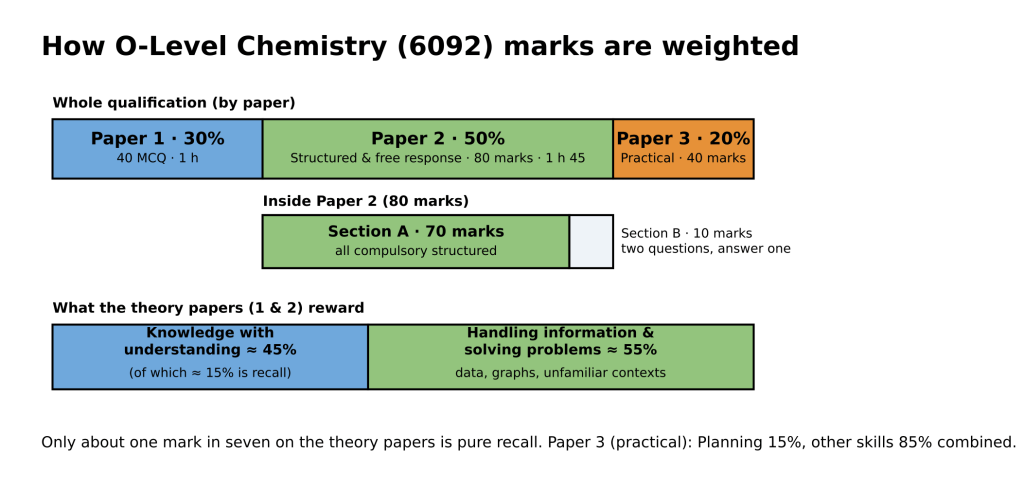
What the marks reward. SEAB’s syllabus states that the theory papers place approximately 45% of marks on Knowledge with Understanding — of which only about 15% is allocated to recall — and approximately 55% on Handling Information and Solving Problems. In practice, only about one mark in seven on the theory papers is pure recall. Revision therefore has to include application, calculations, data interpretation and unfamiliar contexts, not only memorisation. For how to answer the multi-part questions that dominate Paper 2, see Structured Chemistry Questions for O-Level.
Inside Paper 3. Planning carries 15% of the practical marks; manipulation, measurement and observation, presentation of data and observations, and analysis, conclusions and evaluation together carry the other 85%. Because Paper 3 is 20% of the whole qualification, it deserves its own preparation — our O-Level Chemistry Practical Paper 3 guide covers the four skill areas, titration technique and common practical mistakes.
How to Use the Syllabus for Revision
Start with the 12-topic checklist. Use the topic list as a master checklist and mark each topic as secure, developing, or weak, so revision targets real gaps instead of favourite topics.
Revise in dependency order. The topic map shows what unlocks what. Particulate nature, bonding and calculations come first because later topics lean on them; organic chemistry and air quality come later because they reuse those foundations.
Build topic-based notes. Keep definitions, equations, reaction patterns, practical observations and common mistakes together by topic, so each topic is easy to revisit.
Weight practice towards application. With about 55% of theory marks on handling information and solving problems, calculations, graphs, tables and unfamiliar reaction contexts deserve more practice time than re-reading notes.
Treat practical chemistry as a topic, not an event. Paper 3 is 20% of the grade, so know why apparatus are chosen, what observations mean and how methods can be improved — well before Prelims.
Check your notes against the official syllabus. The syllabus is the best test of whether a revision guide or set of school notes covers the required content. Use the official learning outcomes alongside school notes and past-year practice.
This is the syllabus-specific layer. For study techniques that make it stick — active recall, spaced practice, error logs — see O-Level Chemistry Tips to Score A1, and for pacing yourself in the exam hall, O-Level Chemistry Time Management.
Common O-Level Chemistry Syllabus Mistakes
- Assuming Combined Science Chemistry covers fewer topic headings than Pure Chemistry — the headings are the same; the qualification around them differs.
- Using the wrong subject code when looking for the syllabus or past papers (6092 for Pure, 5086 or 5088 for Combined Science, K324 from 2027).
- Treating Paper 3 as an afterthought when it carries 20% of the grade.
- Revising only recall when about 55% of theory marks go to handling information and solving problems.
- Revising the 12 topics as isolated units instead of noticing how bonding, calculations and redox feed later topics.
- Leaving Chemical Calculations until late, even though it underpins so much of the paper.
- Assuming that because the Qualitative Analysis notes are supplied for the practical paper, there is nothing to practise — accurate observations and interpretation are the skill.
- Learning organic chemistry as a flat list instead of by compound family, reaction and conditions.
- Reading the 2027 SEC change as a brand-new syllabus rather than a change of qualification name and subject code.
- Relying on school notes alone without checking them against the official syllabus topic list.
For the exam-hall errors that cost marks even when the content is known, see Chemistry Exam Mistakes Students Make.
Is the O-Level Chemistry Syllabus Changing in 2027?
The qualification is changing; the topic list is not. As part of Full Subject-Based Banding, SEAB states that in 2027 the GCE N(T), N(A) and Ordinary Levels “will be combined and renamed as the Singapore-Cambridge Secondary Education Certificate (SEC)”, with SEAB indicating that examination standards are unchanged. Under the SEC, students “will sit the subjects at the respective subject level (i.e. G1, G2, G3)”.
For Chemistry, the G3 syllabus is coded K324, with 6092 shown as the 2026 and earlier reference code. The published 2027 G3 Chemistry syllabus keeps the same 12 topic headings found in the 2026 6092 syllabus. The main change is therefore the qualification framework and subject coding, not a new set of Chemistry topics. Students should still use the exact syllabus and subject level that applies to their own examination year.
How Pamela’s Place Supports O-Level Chemistry Revision
At Pamela’s Place, O-Level Chemistry revision is organised around the syllabus structure on this page: securing the foundation topics first, building calculation fluency early, and training students to answer application and data-based questions rather than only recall facts. Students are taught in small Omakase groups capped at 7 students, so each learner’s gaps against the 12-topic checklist can be spotted and closed early. The same approach runs across our Chemistry programmes, with the goal of connected understanding that holds up under exam conditions.
O-Level Chemistry Syllabus FAQs
Which O-Level Chemistry syllabus code is examined in 2026?
Pure Chemistry is syllabus 6092. Chemistry also appears in Combined Science under 5086 (Physics, Chemistry) and 5088 (Chemistry, Biology).
- Always use the code for your own subject route when looking up the syllabus or past papers.
How many topics are in the 2026 O-Level Chemistry syllabus?
The official syllabus lists 12 chemistry topics, grouped into three sections: Matter — Structures and Properties, Chemical Reactions, and Chemistry in a Sustainable World.
- Seven of the 12 topics sit in the Chemical Reactions section.
Does Combined Science Chemistry cover the same topics as Pure Chemistry?
At the official topic-heading level, yes. The chemistry section of 5086 and 5088 lists the same 12 topics as 6092.
- The difference is the assessment context: Chemistry is assessed within a broader combined-science qualification.
What is the Combined Science code for Chemistry?
There is no separate standalone code. Chemistry is part of 5086 (Physics, Chemistry) and 5088 (Chemistry, Biology). Physics/Biology (5087) has no chemistry component.
- Pure Chemistry’s own code is 6092.
How is O-Level Pure Chemistry assessed?
Three compulsory papers: Paper 1 (40 multiple-choice questions, 1 hour, 30%), Paper 2 (structured and free-response, 1 hour 45 minutes, 80 marks, 50%) and Paper 3 (practical, 1 hour 50 minutes, 40 marks, 20%).
- Paper 2 includes a data-based question in Section B.
How much of the theory papers is recall?
About 45% of theory marks go to Knowledge with Understanding, and only about 15% of marks are allocated to recall. About 55% go to Handling Information and Solving Problems.
- This is why calculations, graphs and unfamiliar contexts need regular practice.
Is practical Chemistry part of the 2026 syllabus?
Yes. Pure Chemistry 6092 has a separate practical Paper 3 worth 20% of the qualification, and Combined Science also includes a practical paper covering the relevant sciences.
- See the Paper 3 guide for the skill areas and techniques.
Is the O-Level Chemistry syllabus changing in 2027?
The GCE O-Level is combined and renamed as the SEC in 2027. G3 Chemistry becomes K324, and the published syllabus keeps the same 12 topic headings.
- It’s a change of qualification name and subject code, not a new topic structure.
What does G3 mean under the SEC?
Under the SEC, students sit each subject at a subject level — G1, G2 or G3 — as part of Full Subject-Based Banding.
- Check which level applies to you, because the subject code follows the level (K324 is G3 Chemistry).
Does this apply to IP Chemistry students, and what comes after O-Level?
IP students follow a different route, covered in our IP Chemistry Syllabus guide. For students continuing to JC, the next step is the H2 Chemistry Syllabus Explained guide.
- Topics such as bonding, the Periodic Table, energetics and rates return in much greater depth at H2.
Official Sources
Primary SEAB sources used for this guide:
- 2026 GCE O-Level syllabuses for school candidates
- 2026 O-Level Chemistry syllabus 6092 (SEAB PDF)
- 2026 Science (Physics, Chemistry) syllabus 5086 (SEAB PDF) and Science (Chemistry, Biology) 5088 (SEAB PDF)
- 2027 SEC G3 syllabuses for school candidates (SEAB)
- 2027 SEC G3 Chemistry syllabus K324
- SEAB: Secondary Education Certificate (SEC) — seab.gov.sg/secondary-education-certificate-sec
Struggling With Chemistry?
Everything you need to score higher in O Level & A Level Chemistry – from exam tips to study strategies.
