
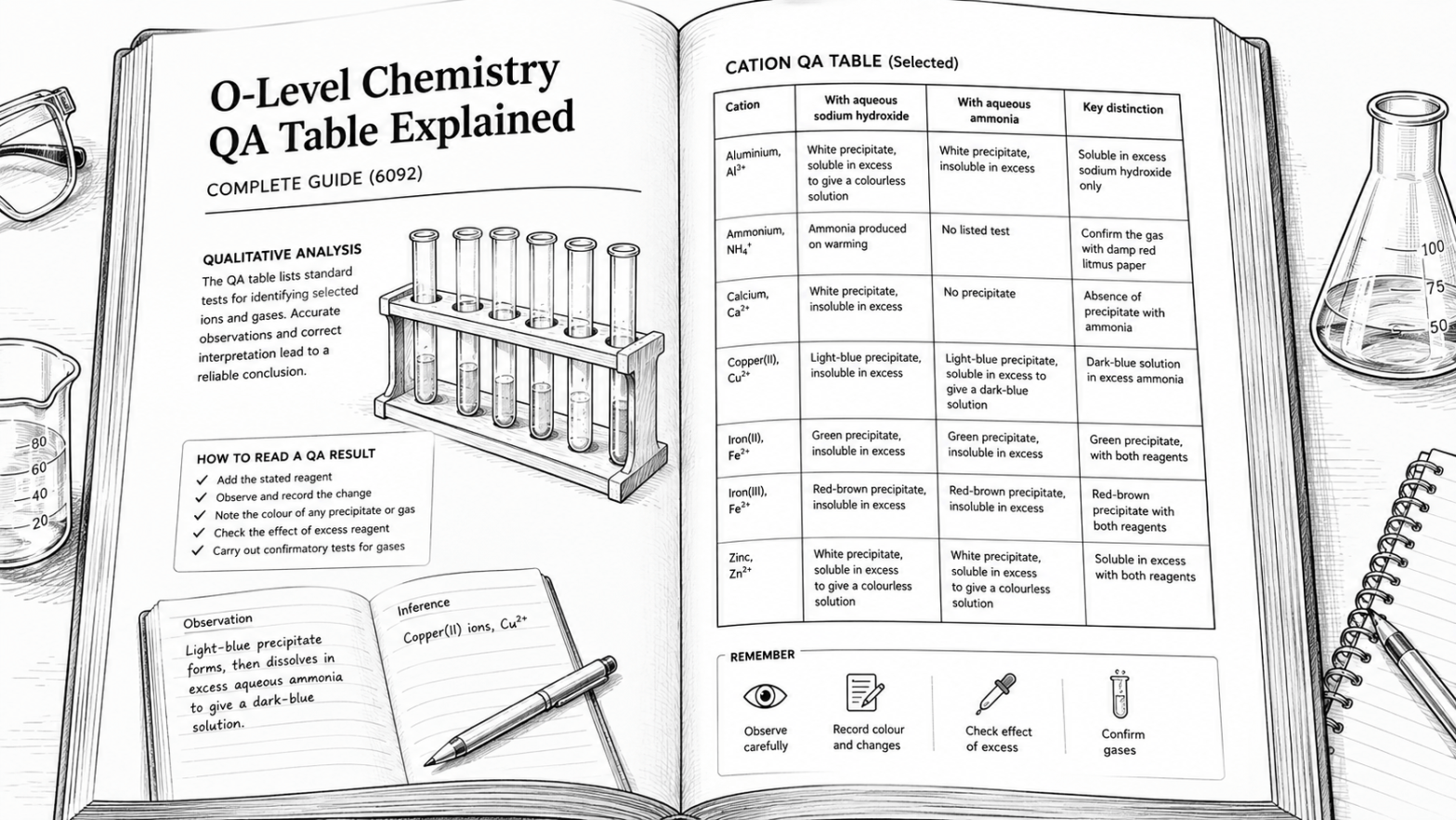
Quick answer: The O-Level Chemistry QA table covers standard tests for 7 aqueous cations, 5 anions, and 6 gases, printed as part of Paper 3. The table alone isn’t enough — three cations (Al³⁺, Ca²⁺, Zn²⁺) all give a white precipitate with sodium hydroxide, so distinguishing them requires comparing behaviour in excess reagent and testing with aqueous ammonia as well. Below is the full table set, worked examples, and the wording that turns a vague observation into a mark-scoring one.
Qualitative analysis becomes much easier when the QA table is treated as a decision-making tool instead of a page of isolated facts to memorise. Every test follows the same sequence: add the stated reagent, observe whether a precipitate or gas forms, record its colour, and check what happens when the reagent is added in excess.
This guide follows the Notes for Qualitative Analysis in the 2026 Singapore-Cambridge O-Level Chemistry syllabus 6092, bringing the cation, anion, and gas tests into one exam-focused resource, then explaining how to separate similar results through colour, solubility, and confirmatory tests. This is the exact skill O-Level Chemistry tuition at Pamela’s Place is built to train — not memorising the table, but using it correctly when the observation is unfamiliar or several ions still seem possible.
Table of Contents
What Is the O-Level Chemistry QA Table?
The O-Level Chemistry QA Table lists standard tests for identifying selected ions and gases. In qualitative analysis, the evidence is descriptive rather than numerical, so a conclusion depends on details like a white precipitate, a light-blue precipitate, or a colourless solution after excess reagent is added.
The official 2026 notes cover 5 anions, 7 aqueous cations, and 6 gases. A copy is printed as part of Paper 3, the practical paper. Even with the table available, students must know how to choose the correct test, carry it out carefully, and describe each observation in enough detail to support a conclusion — the table gives you the data, not the reasoning.
Exam note: The QA notes are supplied in Paper 3. Students are still expected to understand the reactions, interpret linked observations, and apply the same chemistry in theory questions where the notes aren’t provided.
How to Read a QA Result
A complete observation answers four questions: What reagent was added? Did a precipitate or gas form? What colour was seen? What happened after warming or after adding excess reagent? Missing any one part can make an otherwise correct result ambiguous.
- Add reagents slowly and mix well so the first change can be seen
- Use about 1–2 cm³ of solution for a test unless the question states otherwise
- Record the colour and physical change before making an identification
- Continue with excess reagent only when the test requires a solubility comparison
- Name a gas only after carrying out its confirmatory test
“Blue solution” isn’t enough evidence for copper(II) ions. A more useful record: “a light-blue precipitate forms, then dissolves in excess aqueous ammonia to give a dark-blue solution” — this includes the initial colour, the behaviour in excess, and the final appearance.
Struggling With Chemistry?
Everything you need to score higher in O Level & A Level Chemistry – from exam tips to study strategies.
The Definitive Cation QA Table
Aqueous sodium hydroxide and aqueous ammonia are used to compare the behaviour of metal ions. The first result narrows the possibilities; the second often separates ions that give precipitates of the same colour.
| Cation | With aqueous sodium hydroxide | With aqueous ammonia | Key distinction |
| Aluminium, Al³⁺ | White precipitate, soluble in excess to give a colourless solution | White precipitate, insoluble in excess | Soluble in excess sodium hydroxide only |
| Ammonium, NH₄⁺ | Ammonia produced on warming | No listed test | Confirm the gas with damp red litmus paper |
| Calcium, Ca²⁺ | White precipitate, insoluble in excess | No precipitate | The absence of a precipitate with ammonia is decisive |
| Copper(II), Cu²⁺ | Light-blue precipitate, insoluble in excess | Light-blue precipitate, soluble in excess to give a dark-blue solution | Dark-blue solution in excess ammonia |
| Iron(II), Fe²⁺ | Green precipitate, insoluble in excess | Green precipitate, insoluble in excess | Green precipitate with both reagents |
| Iron(III), Fe³⁺ | Red-brown precipitate, insoluble in excess | Red-brown precipitate, insoluble in excess | Red-brown precipitate with both reagents |
| Zinc, Zn²⁺ | White precipitate, soluble in excess to give a colourless solution | White precipitate, soluble in excess to give a colourless solution | Soluble in excess of both reagents |
How to Separate the White Precipitates
Aluminium, calcium, and zinc ions can all produce a white precipitate with aqueous sodium hydroxide — colour alone can’t identify the ion. The distinction comes from adding excess sodium hydroxide, then comparing the result with aqueous ammonia in a fresh portion of the solution.
| Result pattern | Ion |
| Soluble in excess sodium hydroxide, insoluble in excess ammonia | Al³⁺ |
| Insoluble in excess sodium hydroxide, no precipitate with ammonia | Ca²⁺ |
| Soluble in excess sodium hydroxide and excess ammonia | Zn²⁺ |
A common error: identifying aluminium ions as soon as the precipitate dissolves in excess sodium hydroxide. Zinc ions behave the same way — the aqueous ammonia test is needed. Aluminium hydroxide stays as a white precipitate in excess ammonia; zinc hydroxide dissolves to give a colourless solution.
How to Recognise the Coloured Precipitates
The coloured precipitates are more distinctive. Copper(II) ions give a light-blue precipitate, iron(II) ions give a green precipitate, and iron(III) ions give a red-brown precipitate. These are precipitate colours, not solution colours — the word “precipitate” should appear in the observation.
Copper(II) ions have an additional confirmatory clue: the light-blue precipitate dissolves in excess aqueous ammonia to give a dark-blue solution. The iron precipitates remain insoluble in excess of either reagent.
QA Colour Reference
| Colour | Where it appears |
| White | Al³⁺, Ca²⁺ or Zn²⁺ hydroxide precipitate |
| Light-blue | Cu²⁺ hydroxide precipitate |
| Dark-blue | Final solution when Cu²⁺ is treated with excess ammonia |
| Green | Fe²⁺ hydroxide precipitate |
| Red-brown | Fe³⁺ hydroxide precipitate |
| Yellow | Silver iodide precipitate in the iodide test |
Colours in real test-tubes may appear paler or darker depending on concentration, lighting, and reagent volume. Use the accepted colour name together with the type of change — “green precipitate” is stronger evidence than “the mixture became green.”
The Definitive Anion QA Table
Anion tests use a specific reagent sequence. Chloride, iodide, and sulfate tests begin by acidifying with dilute nitric acid, which removes interfering ions without introducing chloride or sulfate ions that could create a misleading precipitate.
| Anion | Test | Positive result | Confirmation or meaning |
| Carbonate, CO₃²⁻ | Add dilute acid | Effervescence: carbon dioxide is produced | Test the gas with limewater |
| Chloride, Cl⁻ | Acidify with dilute nitric acid, then add aqueous silver nitrate | White precipitate | Silver chloride forms |
| Iodide, I⁻ | Acidify with dilute nitric acid, then add aqueous silver nitrate | Yellow precipitate | Silver iodide forms |
| Nitrate, NO₃⁻ | Add aqueous sodium hydroxide, then aluminium foil; warm carefully | Ammonia is produced | Test the gas with damp red litmus paper |
| Sulfate, SO₄²⁻ | Acidify with dilute nitric acid, then add aqueous barium nitrate | White precipitate | Barium sulfate forms |
Why Dilute Nitric Acid Is Used
Carbonate ions and other interfering species may also form precipitates with silver or barium ions. Dilute nitric acid removes the interference, while nitrate ions don’t create a precipitate with the reagent used next.
Hydrochloric acid is unsuitable before the chloride test because it adds chloride ions. Sulfuric acid is unsuitable before the sulfate test because it adds sulfate ions — either choice could produce the very result the test is supposed to detect.
Carbonate and Nitrate Need a Gas Test
Effervescence after adding dilute acid suggests a carbonate, but confirm the gas as carbon dioxide by bubbling it through limewater — look for a white precipitate, which dissolves with excess carbon dioxide.
For nitrate ions, warm the sample carefully with aqueous sodium hydroxide and aluminium foil. If ammonia is produced, hold damp red litmus paper near the mouth of the test tube — the paper turns blue. Don’t place litmus paper in the solution itself, since the alkaline mixture can give a misleading result.
The Definitive Gas-Test Table
| Gas | Test | Positive result |
| Ammonia, NH₃ | Hold damp red litmus paper near the gas | Damp red litmus paper turns blue |
| Carbon dioxide, CO₂ | Bubble the gas through limewater | White precipitate forms; dissolves with excess CO₂ |
| Chlorine, Cl₂ | Expose damp litmus paper to the gas | Damp litmus paper is bleached |
| Hydrogen, H₂ | Apply a lighted splint | The gas gives a pop |
| Oxygen, O₂ | Insert a glowing splint | The glowing splint relights |
| Sulfur dioxide, SO₂ | Pass the gas into aqueous acidified potassium manganate(VII) | Solution changes from purple to colourless |
Practical boundary: the 2026 syllabus states candidates aren’t required to carry out tests involving sulfur dioxide gas. The result still belongs to the supplied gas-test notes and can be used when interpreting the given information.
How to Write High-Scoring Observations
An observation records what is seen, heard, or detected by a stated test — it should not replace the evidence with an ion name. Write the physical change first, then state the inference separately if the question asks for one.
| Too vague | Better observation |
| It turns blue | A light-blue precipitate forms |
| The precipitate disappears | The white precipitate dissolves in excess reagent to give a colourless solution |
| There is a gas | Effervescence is observed; the gas gives a pop with a lighted splint |
| Carbon dioxide is formed | The gas gives a white precipitate with limewater |
| No reaction | No precipitate forms or no visible change is observed |
Use “clear” carefully — a clear solution can still be coloured, while a colourless solution has no colour. When a white precipitate dissolves in excess sodium hydroxide or ammonia, the official notes state that a colourless solution forms — not just “clear.”
A Step-by-Step Method for Unknown Salts
When several tests are available, divide the unknown solution into fresh portions. Reusing the same portion repeatedly can introduce ions from earlier reagents and make later conclusions unreliable.
- Record the original colour and appearance of the sample.
- Test one fresh portion with aqueous sodium hydroxide, first dropwise, then in excess.
- Warm carefully if the ammonium-ion test is required.
- Test another fresh portion with aqueous ammonia, first dropwise, then in excess.
- Use a separate fresh portion for the most suitable anion test.
- Confirm any gas before naming it.
- Match the complete result pattern with the table before stating the ions present.
This order prevents one striking observation from controlling the conclusion too early — a white precipitate with sodium hydroxide is only a starting clue, since aluminium, calcium, and zinc ions all remain possible until behaviour with excess reagent and aqueous ammonia is compared.
Worked O-Level Chemistry QA Questions
1. Identifying copper(II) ions. A student adds aqueous sodium hydroxide to solution P — a light-blue precipitate forms and remains in excess reagent. In a fresh portion, aqueous ammonia gives a light-blue precipitate that dissolves in excess to form a dark-blue solution. The cation is Cu²⁺ — the dark-blue solution in excess ammonia confirms it.
2. Distinguishing aluminium and zinc. Solution Q gives a white precipitate with aqueous sodium hydroxide that dissolves in excess to give a colourless solution. Both Al³⁺ and Zn²⁺ give this result, so it’s not enough alone — add aqueous ammonia to a fresh portion. A white precipitate that remains in excess indicates Al³⁺; one that dissolves in excess to give a colourless solution indicates Zn²⁺.
3. Identifying a carbonate. Dilute acid is added to solid R, and effervescence occurs; the gas gives a white precipitate with limewater. The gas is carbon dioxide, released when a carbonate reacts with dilute acid — R contains CO₃²⁻.
4. Identifying a nitrate. Aqueous sodium hydroxide and aluminium foil are added to solution S, then warmed carefully — a pungent gas turns damp red litmus paper blue. The gas is ammonia, and its production under these conditions indicates NO₃⁻.
5. Identifying both ions. Solution T gives a green precipitate with both aqueous sodium hydroxide and aqueous ammonia, insoluble in excess of either. A fresh portion, acidified with dilute nitric acid, gives a white precipitate with aqueous barium nitrate. The green precipitate identifies Fe²⁺; the barium nitrate result identifies SO₄²⁻ — solution T contains iron(II) sulfate.
6. Planning a distinguishing test. Two colourless solutions contain calcium ions and zinc ions, unlabelled. Add aqueous ammonia slowly to separate portions, then in excess. Calcium ions give no precipitate; zinc ions give a white precipitate that dissolves in excess to a colourless solution.
Common QA Misconceptions
- A white precipitate identifies the ion — white precipitates occur in several tests; the ion must be identified through the reagent used, its behaviour in excess, and a second confirmatory test where needed.
- More reagent always gives a stronger precipitate — excess reagent can dissolve a precipitate, which is the key distinction for aluminium, zinc, and copper(II) ions. Record both the initial result and the result in excess.
- Any acid can be used for acidification — the official chloride, iodide, and sulfate procedures use dilute nitric acid specifically; hydrochloric or sulfuric acid may introduce the ion being tested and cause a false positive.
- The smell of a gas is a confirmatory test — smell should never be used as evidence, and gases should never be inhaled directly; use the stated test only.
- A clear solution must be colourless — “clear” describes transparency, not colour; a dark-blue copper(II) solution can be clear.
Revision Strategies for the Chemistry QA Table
The fastest way to learn the QA table is to organise it around contrasts, not a flat list. Group the white cation precipitates together, learn the three coloured cation precipitates as a set, and connect every gas with one unmistakable test.
- Practise from observation to ion, and from ion to observation, in both directions
- Cover the ion column and identify each species from the complete result
- Write paired comparisons — aluminium versus zinc, chloride versus iodide
- Say the observation aloud using “precipitate,” “excess,” and “colourless solution” correctly
- Mix cation, anion, and gas clues in one question so the decision process becomes automatic
Short, frequent recall beats repeatedly rereading the table. A five-minute routine can cover three cation patterns, one anion reagent sequence, and two gas tests, followed by one unfamiliar set of observations.
Printable O-Level Chemistry QA Summary
Aqueous cations
| Ion | NaOH(aq) | NH₃(aq) |
| Al³⁺ | White PPT.; soluble in excess, colourless solution | White PPT.; insoluble in excess |
| NH₄⁺ | Ammonia on warming | No listed test |
| Ca²⁺ | White PPT.; insoluble in excess | No PPT. |
| Cu²⁺ | Light-blue ppt.; insoluble in excess | Light-blue ppt.; soluble in excess, dark-blue solution |
| Fe²⁺ | Green ppt.; insoluble in excess | Green ppt.; insoluble in excess |
| Fe³⁺ | Red-brown ppt.; insoluble in excess | Red-brown ppt.; insoluble in excess |
| Zn²⁺ | White PPT.; soluble in excess, colourless solution | White PPT.; soluble in excess, colourless solution |
Anions
| Ion | Test | Positive result |
| CO₃²⁻ | Add dilute acid | Effervescence; CO₂ produced |
| Cl⁻ | Dilute HNO₃, then AgNO₃(aq) | White PPT. |
| I⁻ | Dilute HNO₃, then AgNO₃(aq) | Yellow ppt. |
| NO₃⁻ | NaOH(aq), then aluminium foil; warm | NH₃ produced |
| SO₄²⁻ | Dilute HNO₃, then Ba(NO₃)₂(aq) | White ppt. |
Gases
| Gas | Positive test |
| NH₃ | Turns damp red litmus paper blue |
| CO₂ | White ppt. with limewater; dissolves with excess CO₂ |
| Cl₂ | Bleaches damp litmus paper |
| H₂ | Pops with a lighted splint |
| O₂ | Relights a glowing splint |
| SO₂ | Turns acidified KMnO₄(aq) from purple to colourless |
This QA table is one part of the wider Paper 3 practical — for titration technique, rates of reaction, and planning-question strategy, see our O-Level Chemistry Practical (Paper 3) guide, which covers the full practical paper; this page is the deep dive on qualitative analysis specifically.
How Pamela’s Place Supports O-Level Chemistry Revision
At Pamela’s Place, O-Level Chemistry tuition is built around clear explanations, deliberate practice, and precise exam language. Students learn how to connect an observation to the underlying reaction, compare closely related ions, and present conclusions supported by experimental evidence — in small Omakase groups capped at 7 students.
For qualitative analysis specifically, this means moving beyond a memorised colour list. Students practise reagent selection, test sequences, observation wording, and mixed-ion questions until the QA table becomes a reliable problem-solving framework rather than a page to recall under pressure. The same reasoning-first approach carries through to A-Level (H2) Chemistry and IP Chemistry, where qualitative analysis resurfaces in more integrated, less signposted questions.
O-Level Chemistry QA Table FAQs
1. Is the QA table provided in the O-Level Chemistry examination?
Yes — the 2026 syllabus states that the Notes for Qualitative Analysis are printed as part of Paper 3.
- Students should still know how to select tests, follow the reagent sequence, and interpret complete observations, since the notes give data, not methods.
2. Which cations give a white precipitate with aqueous sodium hydroxide?
Al³⁺, Ca²⁺, and Zn²⁺ all give white precipitates.
- Aluminium and zinc precipitates dissolve in excess sodium hydroxide; the calcium precipitate remains insoluble.
3. How can aluminium ions be distinguished from zinc ions?
Use aqueous ammonia on fresh portions — both give a white precipitate with sodium hydroxide, but they behave differently with ammonia.
- The aluminium precipitate is insoluble in excess ammonia; the zinc precipitate dissolves to give a colourless solution.
4. What’s the difference between the chloride and iodide tests?
4. What’s the difference between the chloride and iodide tests?
Both solutions are acidified with dilute nitric acid before aqueous silver nitrate is added.
- Chloride ions give a white precipitate; iodide ions give a yellow precipitate.
5. What’s the best way to memorise gas tests?
Link each gas to one action and one result, rather than a flat list.
- Hydrogen pops with a lighted splint; oxygen relights a glowing splint; carbon dioxide gives a white precipitate with limewater; ammonia turns damp red litmus paper blue; chlorine bleaches damp litmus paper; sulfur dioxide decolourises acidified potassium manganate(VII).
6. Is qualitative analysis tested in A-Level (H2) Chemistry too?
Yes — H2 Chemistry also supplies Qualitative Analysis Notes for the practical paper, building on the same reagent-and-observation logic covered here rather than replacing it.
- The core skill — reading a result as reagent, colour, and behaviour in excess — carries forward directly; H2 questions tend to combine it with other topics rather than testing it in isolation the way O-Level often does.
- See our A-Level (H2) Chemistry tuition page for how this progression is handled.
7. Does IP Chemistry use the same QA table as O-Level Chemistry?
The underlying chemistry and reagent logic are the same, but IP students meet qualitative analysis on a different timeline and without an O-Level checkpoint forcing mastery of it at a fixed point.
- This makes it easier for a shaky QA foundation to go unnoticed for longer in the IP track — worth checking deliberately rather than assuming it’s secure.
- See our IP Chemistry tuition page for how we address this specifically.
8. How does this relate to the H2 Chemistry Data Booklet?
The Data Booklet’s Qualitative Analysis Notes section is the H2-level equivalent of the table on this page — same purpose, supplied for the practical paper, data given but reasoning still required.
- If you’re moving between O-Level and H2 Chemistry, our H2 Chemistry Data Booklet guide covers how that section fits alongside the rest of the booklet.
Official Reference
Singapore-Cambridge GCE Ordinary Level Chemistry 6092 syllabus for examination in 2026, including the Notes for Qualitative Analysis.
