
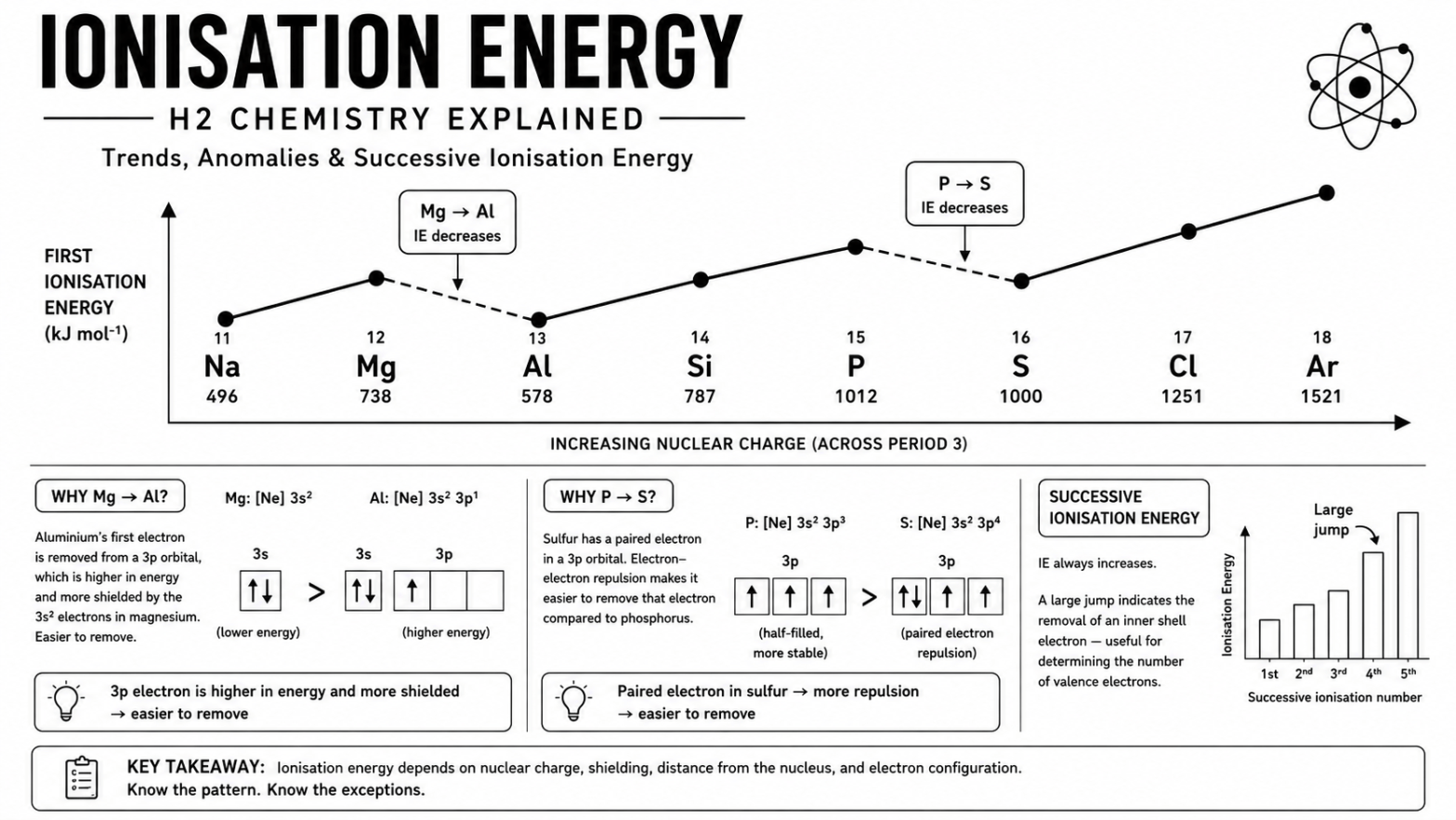
Quick answer: Ionisation energy is the energy needed to remove an electron from a gaseous atom or ion. First ionisation energy generally increases across a period (rising nuclear charge, similar shielding) and decreases down a group (electron further from the nucleus, more shielding). Two exceptions in Period 3 — aluminium being lower than magnesium, and sulfur being lower than phosphorus — come down to which specific electron is removed, not just nuclear charge. Successive ionisation energies always increase, and a large jump between two values reveals a shell boundary, which is how you identify an element’s number of valence electrons from data alone.
Ionisation energy is one of the most important ideas in H2 Chemistry because it connects atomic structure to the Periodic Table — students use it to explain trends, compare elements, and deduce electronic configurations from numerical data. It can feel confusing when every answer seems to mention nuclear charge, shielding, and distance, but each factor has a specific, distinct role, and knowing which one actually applies to a given comparison is what separates a vague answer from a precise one. This is exactly the kind of precision built into H2 Chemistry tuition at Pamela’s Place, where students practise identifying which factor is decisive for a specific comparison rather than listing all of them by default.
For the revised Singapore-Cambridge H2 Chemistry syllabus 9476, students must explain the factors influencing ionisation energies, deduce electronic configurations from successive ionisation energy data, and interpret an element’s position in the Periodic Table from that data — this guide covers all three, with trend explanations, worked examples, Cambridge-style questions, and the misconceptions that cost the most marks.
Table of Contents
What Is Ionisation Energy?
Ionisation energy is the energy required to remove electrons from gaseous particles. The word gaseous is essential — the definition refers to separate atoms or ions without intermolecular forces or a lattice affecting the measurement.
First ionisation energy is the energy required to remove one electron from each atom in one mole of gaseous atoms to form one mole of gaseous 1+ ions:
X(g) → X⁺(g) + e⁻
The unit is kJ mol⁻¹. The equation must show a gaseous atom on the left, a gaseous ion on the right, and exactly one electron removed — writing an aqueous or solid species changes the process and doesn’t represent first ionisation energy.
Successive ionisation energies describe removing additional electrons from increasingly positive gaseous ions. The second ionisation energy removes an electron from X⁺(g); the third removes an electron from X²⁺(g):
Second: X⁺(g) → X²⁺(g) + e⁻ Third: X²⁺(g) → X³⁺(g) + e⁻
Each equation removes only one electron — update the ionic charge carefully rather than writing all removed electrons in one step.
Struggling With Chemistry?
Everything you need to score higher in O Level & A Level Chemistry – from exam tips to study strategies.
Factors Affecting Ionisation Energy
An electron is attracted to the positively charged nucleus. Ionisation energy depends on how strongly that electron is attracted and how much energy is needed to overcome the attraction.
- Nuclear charge — more protons create a stronger electrostatic attraction, provided other factors are comparable. The proton number increases one step at a time across a period.
- Distance from the nucleus — an electron further away experiences weaker attraction. In a group, the outer electron occupies a shell with a higher principal quantum number, increasing its average distance.
- Shielding effect — inner-shell electrons repel outer electrons, reducing the attraction felt from the nucleus. In a group, more occupied inner shells mean more significant shielding.
- Sub-shell energy — electrons in different sub-shells have different energies. Within the same principal shell, a p electron is generally higher in energy and less strongly attracted than an s electron — this explains the first major anomaly across Period 3.
- Inter-electronic repulsion — two electrons in the same orbital repel each other, so a paired electron can be easier to remove than an unpaired electron in a comparable orbital. This explains the second major anomaly across Period 3.
First Ionisation Energy Trend Across Period 3
First ionisation energy generally increases from sodium to argon. Nuclear charge increases across the period while the electron removed stays in the third principal shell, with broadly similar shielding from the inner shells — so the increasing nuclear attraction makes the outer electron harder to remove.
The trend isn’t perfectly smooth: aluminium has a lower first ionisation energy than magnesium, and sulfur has a lower first ionisation energy than phosphorus.
Why Is Aluminium’s First Ionisation Energy Lower Than Magnesium’s?
Mg: [Ne] 3s² Al: [Ne] 3s² 3p¹
The electron removed from aluminium is a 3p electron; the electron removed from magnesium is a 3s electron. The 3p electron is higher in energy and more shielded from the nucleus than the 3s electron, so it’s less strongly attracted and requires less energy to remove.
A high-scoring answer compares the specific electrons removed. Saying only that aluminium has a larger atomic radius isn’t precise enough and may miss the sub-shell difference the mark scheme is looking for.
Why Is Sulfur’s First Ionisation Energy Lower Than Phosphorus’s?
P: [Ne] 3s² 3p³ S: [Ne] 3s² 3p⁴
Phosphorus has three unpaired electrons in separate 3p orbitals. Sulfur has one pair of electrons in a single 3p orbital. Repulsion between the paired electrons makes one of them easier to remove, so sulfur has a lower first ionisation energy despite its higher nuclear charge.
The phrase “half-filled sub-shell is more stable” is often used but doesn’t fully explain the comparison. Cambridge-style answers should identify the paired electron and the inter-electronic repulsion within that specific orbital.
First Ionisation Energy Trend Down a Group
First ionisation energy generally decreases down a group. The outer electron occupies a shell further from the nucleus and experiences greater shielding from additional inner shells — these effects outweigh the increase in nuclear charge.
For example, the first ionisation energies of lithium, sodium, and potassium are 519, 494, and 418 kJ mol⁻¹. This decrease isn’t explained by lower nuclear charge — nuclear charge actually increases down the group — it’s explained by the greater distance and shielding experienced by the outer electron.
Why Successive Ionisation Energies Increase
Successive ionisation energies increase because each electron is removed from an ion with greater positive charge — the remaining electrons experience stronger attraction to the nucleus, so more energy is needed for each further removal.
The increase is gradual while electrons are removed from the same principal shell. A very large jump occurs when the next electron must be removed from an inner shell, which is closer to the nucleus, experiences less shielding, and is much more strongly attracted.
Successive ionisation energy data (kJ mol⁻¹):
| Element | 1st IE | 2nd IE | 3rd IE | 4th IE | Largest Early Jump |
| Na | 494 | 4560 | 6940 | 9540 | After the 1st |
| Mg | 736 | 1450 | 7740 | 10500 | After the 2nd |
| Al | 577 | 1820 | 2740 | 11600 | After the 3rd |
Using a Large Jump to Identify the Group
For a main-group element, the number of electrons removed before the large jump shows the number of valence electrons. A jump after the first value suggests Group 1, after the second suggests Group 2, and after the third suggests Group 13.
The modern group number needs careful interpretation — three valence electrons correspond to Group 13, not Group 3. The rule also becomes less direct for transition elements, since 4s and 3d electrons are relatively close in energy.
Using Successive Data to Identify the Period
A large jump identifies a shell boundary, but doesn’t always identify the period on its own — students may need to compare numerical values against the Data Booklet, use the proton number, or combine the pattern with other chemical information.
If the data is 577, 1820, 2740, and 11600 kJ mol⁻¹, the large jump after the third electron shows three valence electrons. Matching the values against the Data Booklet identifies aluminium — Period 3, Group 13.
Ionisation Energy Across the First-Row Transition Elements
First ionisation energies from scandium to copper are relatively invariant compared with Period 3’s clearer rise. Nuclear charge increases across the series, but the added 3d electrons provide increasing shielding, and the electron removed is generally a 4s electron — these competing effects lead to smaller, less regular changes.
Avoid claiming transition-element ionisation energies are identical — the values fluctuate, just with limited overall variation compared to s-block and p-block trends. (For the fuller picture on transition-element chemistry beyond ionisation energy, see our H2 Chemistry Syllabus guide, Topic 13)
Worked Cambridge-Style Examples
1. Writing an ionisation energy equation. Question: Write an equation for the third ionisation energy of magnesium. Mg²⁺(g) → Mg³⁺(g) + e⁻ — the third ionisation begins with the 2+ gaseous ion, since two electrons have already been removed, and only one electron is removed in this step.
2. Comparing magnesium and aluminium. Question: The first ionisation energies of magnesium and aluminium are 736 and 577 kJ mol⁻¹. Explain why aluminium is lower. Magnesium loses a 3s electron; aluminium loses a 3p electron. The 3p electron is higher in energy and more shielded from the nucleus, experiencing weaker attraction, so less energy is required to remove it.
3. Comparing phosphorus and sulfur. Question: Explain why the first ionisation energy decreases from phosphorus to sulfur. Phosphorus ([Ne] 3s² 3p³) has three unpaired 3p electrons. Sulfur ([Ne] 3s² 3p⁴) has one paired 3p orbital. Repulsion between the paired electrons makes one easier to remove, outweighing the increase in nuclear charge.
4. Deducing a group from data. Question: An element has successive ionisation energies of 590, 1150, 4940, and 6480 kJ mol⁻¹. Deduce its group and identify the element using the Data Booklet. The large jump occurs between the second and third values, so the atom has two valence electrons and belongs to Group 2. The values match calcium.
5. Explaining a downward trend in Group 1. Question: Explain why potassium’s first ionisation energy is lower than sodium’s. The electron removed from potassium is in the 4s subshell; sodium’s is in the 3s subshell. The potassium electron is further from the nucleus and experiences greater shielding from inner shells, so it’s less strongly attracted and requires less energy to remove.
How to Answer Ionisation Energy Questions
A clear comparison moves from the data to the electronic explanation, in this order:
- State the trend or comparison shown by the values.
- Identify the electron or subshell being removed.
- Compare nuclear charge, shielding, distance, or electron pairing — whichever is relevant.
- State how that factor changes the attraction between the nucleus and the electron.
- Conclude which electron requires more or less energy to remove.
Not every factor needs to appear in every answer. Across a period, nuclear charge and subshell details are usually decisive. Down a group, distance and shielding matter most. For an anomaly, focus on the specific electronic difference that reverses the general trend — not every factor at once.
Common Ionisation Energy Misconceptions
- First ionisation energy removes an electron from a gaseous atom, not a solid atom or aqueous ion
- A higher nuclear charge doesn’t guarantee a higher value when distance, shielding, or sub-shell energy changes
- Shielding doesn’t increase much across one period, since added electrons enter the same principal shell
- Atomic radius is a useful description, but the answer should explain distance and electrostatic attraction directly
- The aluminium anomaly is caused by removing a higher-energy 3p electron, not simply “a bigger atom”
- The sulfur anomaly is caused by repulsion between paired 3p electrons specifically
- Successive ionisation energies never remove several electrons in one equation
- A large jump shows a shell change, not an “unusually reactive” electron
- A jump after three electrons suggests Group 13 for a main-group element, not Group 3
- The Data Booklet provides values, but students must still explain the pattern using atomic structure
Quick Revision Summary
| Pattern | Observation | Main Explanation |
| Across a period | Generally increases | Nuclear charge increases while shielding stays broadly similar |
| Down a group | Generally decreases | Outer electron is further away and more shielded |
| Mg → Al anomaly | Decreases | Al loses a higher-energy, more shielded 3p electron |
| P → S anomaly | Decreases | S loses a paired 3p electron with greater inter-electronic repulsion |
| Successive values | Increase | The ion becomes more positive after each removal |
| Very large jump | Shell boundary | The next electron is removed from a closer, less shielded inner shell |
For the other Period 3 and Group 2/17 trends — atomic radius, ionic radius, electronegativity, melting point, and conductivity — see our complete Periodic Table guide for H2 Chemistry, which covers ionisation energy at an overview level alongside those trends; this page is the fuller breakdown of ionisation energy specifically.
How Pamela’s Place Supports H2 Chemistry Revision
At Pamela’s Place, ionisation energy is taught through electronic configurations, comparison frameworks, and exam-focused practice. Students learn when to use nuclear charge, shielding, distance, sub-shell energy, and electron-pair repulsion — rather than memorising one explanation and reapplying it to every trend regardless of fit.
Lessons include worked data questions, Cambridge-style explanations, and targeted feedback on scientific language, in small Omakase groups capped at 7 students. This helps students interpret unfamiliar values, identify large jumps, and write concise answers that link evidence directly to atomic structure.
Ionisation Energy FAQs
1. What is the first ionisation energy?
It’s the energy required to remove one electron from each atom in one mole of gaseous atoms, forming one mole of gaseous 1+ ions.
- The gaseous state is essential to the definition — solid or aqueous species don’t count.
2. Why does first ionisation energy generally increase across a period?
Nuclear charge increases while the electron removed stays in the same principal shell with broadly similar shielding, so attraction to the nucleus strengthens.
- This is the “default” explanation — the two Period 3 anomalies below are the exceptions to know.
3. Why does ionisation energy decrease down a group?
The outer electron is further from the nucleus and experiences greater shielding from additional inner shells, and these effects outweigh the higher nuclear charge.
- Nuclear charge still increases down a group — it’s just outweighed by distance and shielding.
4. Why is aluminium’s ionisation energy lower than magnesium’s?
Aluminium loses a higher-energy 3p electron, while magnesium loses a 3s electron; the aluminium electron is more shielded and less strongly attracted.
- This is a sub-shell effect, not a simple “bigger atom” explanation.
5. Why is sulfur’s ionisation energy lower than phosphorus’s?
Sulfur has a pair of electrons in one 3p orbital; repulsion within that pair makes one electron easier to remove than phosphorus’s unpaired 3p electron.
- This is an inter-electronic repulsion effect, distinct from the aluminium/magnesium sub-shell effect.
6. Why do successive ionisation energies increase?
After each removal, the ion becomes more positively charged, and the remaining electrons are attracted more strongly to the nucleus.
- The increase is gradual within a shell, then jumps sharply at a shell boundary.
7. What does a large jump in successive ionisation energy mean?
It means the next electron is being removed from an inner principal shell, which is closer to the nucleus and less shielded.
- Counting electrons removed before the jump reveals the number of valence electrons.
8. Are ionisation energy values provided in the examination?
The H2 Chemistry Data Booklet provides the first four ionisation energies for selected elements.
- Students must still know how to interpret and explain the values — the booklet gives data, not the reasoning.
