Every parent searching for Chemistry or Biology tuition in Singapore eventually reaches the same question: how do you know if a centre is actually the right fit before committing to weeks of fees and a locked-in schedule?
Reviews help. Recommendations from other parents help. But neither of these answers the most important question — whether the teaching style, classroom environment, and pace are right for your child specifically.
That’s what the trial lesson at Pamela’s Place is designed to answer. Not a promotional session, not a shortened introduction — a genuine lesson that shows you exactly what ongoing tuition looks like, before you commit to anything.
This guide explains how the trial class works, what your child will experience, what Ms Pamela observes during the session, and what happens next — so you can walk in knowing what to expect.
Why Most Trial Classes Don’t Tell You Enough
Across Singapore’s tuition landscape, “trial class” means different things at different centres.
Some offer a free 30-minute consultation where a tutor talks about their programme. Some run a shortened taster session with simplified content — interesting enough, but not representative of how the class actually runs week to week. Others charge a standard lesson fee and call it a trial, which at least means the content is real, but still doesn’t give parents a way to evaluate whether the environment is right.
The most common problem with all of these is the same: they’re optimised to impress, not to inform.
A chemistry tuition trial class or biology tuition trial that’s been specially prepared for prospective students tells you how good the tutor is at presenting. It doesn’t tell you how a confused student gets handled in the middle of a lesson. It doesn’t tell you how questions from different students at different levels are managed simultaneously. It doesn’t tell you whether the pace will suit your child or leave them behind.
The only way to get that information is to attend a real class.

What Makes the Trial at Pamela’s Place Different
At Pamela’s Place, the trial lesson gives you an exclusive spot in a genuine class — all lesson materials included, with no hidden charges beyond the trial itself.
More importantly, it runs as a genuine class with enrolled students, covering real syllabus content at a regular pace.
There is no simplified introduction. No adjusted difficulty. No showcase structure is designed to look impressive. Your child sits in the same lesson that every other enrolled student attends that week — and experiences firsthand what they’d be joining.
This is the most honest way to evaluate a tuition programme. And it’s the approach that gives both the student and Ms Pamela the information they actually need to make a good decision.
What Your Child Will Experience During the Trial
From the moment your child walks into the trial lesson, they participate as a full member of the class. Here’s what that looks like in practice.
Active Participation — Not Passive Observation
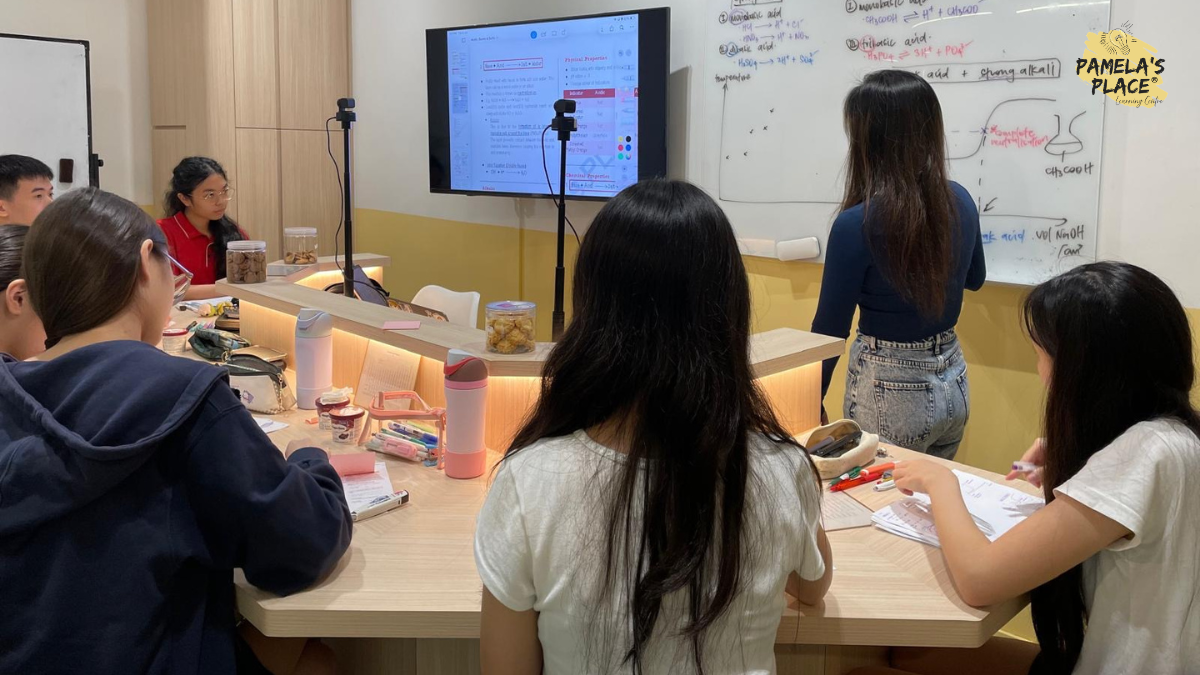
Pamela’s Place lessons are built around active learning, not one-way content delivery. Ms Pamela doesn’t lecture while students copy notes. Students are questioned throughout — asked to explain concepts back, work through problems in real time, and engage with what’s being taught rather than just receiving it.
For a student attending a chemistry tuition trial class or biology tuition trial, this means they’ll be asked questions. They’ll work through problems alongside other students. They’ll see how misconceptions get addressed in real time rather than waiting until the next homework marking.
This can feel unfamiliar — particularly for students used to large school classes where raising your hand is a commitment. But in a group of 4 to 6 students, the dynamic is fundamentally different. Questions are welcomed, wrong answers are learning opportunities, and the pace allows space for genuine explanation rather than surface-level coverage.
Most students adapt quickly. Many find it a relief.
Real Syllabus Content at Regular Pace
The trial covers actual curriculum content relevant to the group your child joins. If the class is working through O-Level chemical bonding or H2 reaction kinetics that week, that’s what your child will experience — not a gentler topic chosen to make the entry point feel easier.
This matters because it gives you an accurate benchmark. You’re not evaluating an introductory session optimised for new students. You’re seeing the real programme.
The Teaching Style in Full
Every tutor is different, and teaching style is one of the hardest things to evaluate from a website. The trial lesson is where you see it directly.
During the class, you’ll observe how Ms Pamela handles a student who is clearly stuck — whether she redirects the question to build reasoning, provides a scaffold, or simply supplies the answer. You’ll see how she connects topics across the syllabus rather than treating each chapter in isolation. You’ll see how she manages different students moving at different speeds within the same small group.
For parents who have previously experienced tuition that amounted to a faster version of school lessons, the difference tends to be apparent within the first twenty minutes.
What Ms Pamela Observes During the Trial
The trial lesson isn’t only an opportunity for your family to evaluate Pamela’s Place. It’s an equally important opportunity for Ms Pamela to understand your child.
With over 12 years of teaching experience and more than 500 students across O-Level, IP, and JC levels, Ms Pamela has developed a precise ability to identify not just what a student gets wrong — but why. During the trial, she pays attention to:

The nature of errors. Is the student making conceptual mistakes, or presentation mistakes? These require entirely different interventions. A student who understands the chemistry but writes vague, incomplete responses needs exam technique work. A student whose response structure is fine but whose underlying concepts are shaky needs foundational rebuilding. Conflating the two is one of the most common reasons tuition doesn’t produce the expected improvement.
Confidence patterns. Many students who appear to struggle with content are actually struggling with confidence — they hesitate to commit to an answer, second-guess themselves, or write very little to avoid being wrong. Identifying this early changes how support is structured from the first proper lesson.
Learning pace and processing style. Some students build understanding step by step and need each layer confirmed before moving forward. Others grasp ideas quickly but lose precision in application. Understanding this in the trial lesson means subsequent classes are structured appropriately from day one rather than recalibrating after several weeks.
Fit with the existing group. The ultimate purpose of this observation is accurate class placement — ensuring your child joins a group that is genuinely matched to their pace, not just their school year.
How Class Placement Works After the Trial
One of the most distinctive aspects of Pamela’s Place is the omakase-styled class matching — students are placed into groups based on learning pace and current conceptual level, not simply by which school year they’re in.
This matters more than it might seem. Two Secondary 4 students preparing for the same O-Level Chemistry paper can be in very different learning positions. One may have strong foundations and need refinement in exam technique. The other may have gaps in core topics that need to be addressed before exam technique can be meaningfully developed. Placing them in the same group and teaching to the middle serves neither of them well.
The trial lesson gives Ms Pamela the information she needs to make a genuine placement recommendation — one based on real observation rather than a grade report or self-assessment.
After the trial, she will share her observations and recommend the most suitable class. This is a direct, honest conversation — not a sales pitch. If a different class would serve your child better than the one they trialled, she will say so.
For a fuller understanding of why this matching process makes such a significant difference to outcomes, the article on why small group tuition works better for science subjects covers the reasoning in detail.
What to Bring to the Trial Lesson
No preparation is required. Ms Pamela provides all lesson materials, and the class runs regardless of what your child has or hasn’t covered recently.
A few things make the trial more useful:
Bring a recent Chemistry or Biology result if you have one. A marked test paper, weighted assessment, or mid-year examination gives Ms Pamela useful context — not to evaluate the grade, but to understand the pattern of errors. Where a student consistently loses marks tells you a great deal about what kind of support they need.
Let Ms Pamela know the level and subject in advance. This allows her to place your child in the most relevant existing class for the trial — whether that’s Sec 3 O-Level Chemistry, JC2 H2 Biology, or IP Upper Secondary Biology. A well-matched trial is more informative than a generic one.
Come with questions. Many parents treat the trial as a purely passive observation. It’s also your opportunity to ask Ms Pamela directly about her approach to students who are significantly behind, how progression across the academic year is structured, and what is expected of students outside of class hours. These questions are worth asking before committing, and Ms Pamela is direct in her answers.
Thinking about a trial lesson in Singapore for your child?
Trial lessons at Pamela’s Place are available for O-Level, IP, and JC Chemistry and Biology, with all materials included. Slots fill up quickly around major exam periods.
Which Subjects and Levels Can Be Trialled
Trial lessons are available across all programmes at Pamela’s Place:
Chemistry
- O-Level Pure Chemistry — Secondary 3 and 4. Conceptual foundations, mole calculations, organic chemistry, and structured exam technique are aligned with the MOE O-Level syllabus.
- H2 Chemistry — JC1 and JC2. Physical, inorganic, and organic chemistry with cross-topic application and A-Level free-response technique.
- IP Chemistry — Upper Secondary Integrated Programme. Structured to address the faster pace and greater depth of the IP syllabus and prepare students for the JC transition.
Biology
- O-Level Pure Biology — Secondary 3 and 4. Structured question technique, application, and concept clarity across the full MOE Biology syllabus.
- H2 Biology — JC1 and JC2. Molecular biology, genetics, ecology, and applied biology with emphasis on extended free-response answers.
- IP Biology — Upper Secondary Integrated Programme. Foundation building and cross-topic integration for students on the IP track.
If you’re unsure which level or programme is the right fit for your child, Ms Pamela can advise before the trial takes place.
What Students Say After Their First Lesson
For many students, the trial is where something shifts — often for the first time in a subject they’d started to give up on.
“Even though I joined the Chemistry tuition extremely late (mid June), it was extremely helpful as I improved greatly from E8 in Prelim 1 to B4 in Prelim 2 and got a distinction in O-Levels.”
“If there were a six-star option, I would choose that, but there isn’t. I joined her Chemistry intensive revision class, then decided to continue weekly lessons afterwards for Biology and Chemistry as the tuition was just THAT GOOD.”
“Her lessons are engaging, and she constantly asks questions to keep our minds awake. She has been the only tutor to teach me inheritance in a way I actually understand.”
These students came in not knowing what to expect. Several had tried other tuition arrangements that hadn’t worked. The trial lesson was what made the difference in their decision to enrol — and in many cases, the first session where a concept they’d been stuck on finally made sense.
More student results and feedback on the success stories page →
After the Trial: What Happens Next
After the lesson, Ms Pamela will give you her honest read — what she observed, what class placement she recommends, and what areas she would prioritise in the first weeks of tuition.
There is no obligation to enrol. The recommendation is specific to your child and offered because correct placement genuinely matters to outcomes — not as a conversion tactic.
Most families who attend a trial make their decision within a few days. If you decide to proceed, enrolment is simple: confirm the class slot, and your child joins as a fully enrolled student from the next available session.
If the trial reveals that Pamela’s Place isn’t the right fit — for whatever reason — that’s still a useful outcome. Better to know after one lesson than after a full term.
Key Takeaways
- The trial lesson gives you an exclusive spot in a genuine class — all materials included
- It runs as a real class with enrolled students, covering genuine syllabus content at a regular pace
- Ms Pamela observes the new student throughout to diagnose learning gaps, confidence patterns, and pace, informing accurate class placement
- Students are matched to groups by learning pace and conceptual level, not just school year
- Trial lessons are available for O-Level, IP, and JC Chemistry and Biology
- No preparation required — but bringing a recent marked paper makes the trial more informative
Frequently Asked Questions
1. What’s included in the trial lesson?
The trial gives your child an exclusive spot in a genuine, fully-run class — not a shortened or simplified demo. All lesson materials are included, and your child experiences exactly what an enrolled student would that week.
2. How is a trial tuition class in Singapore different from just signing up?
The trial allows your child to experience the actual lesson environment before committing. It also gives Ms Pamela the opportunity to observe how your child thinks and learns, which informs class placement. It’s the most reliable way to evaluate fit before enrolling.
3. What is the difference between a chemistry tuition trial class and a regular class at Pamela’s Place?
There is no structural difference. Your child attends the same lesson, covers the same content, and participates in the same way as enrolled students. The only distinction is that Ms Pamela also observes the new student for class placement purposes.
4. How do I book a biology or chemistry tuition trial in Singapore?
Contact Pamela’s Place directly through the contact page. Provide your child’s level and subject so the most relevant class can be arranged.
5. How many students are in a trial class?
Classes are capped at 4 to 6 students. Your child will not be in a large room with 20 strangers — the environment is small, familiar, and designed to make participation feel safe.
6. What if my child finds the trial class too difficult?
Raise this with Ms Pamela after the lesson. If a more foundational group is a better fit, she will advise accordingly. The goal of the trial is accurate placement — not pushing students into classes that don’t match their level.
7. Can my child trial both Chemistry and Biology?
Yes. If your child is considering tuition for both subjects, separate trial lessons can be arranged for each. Get in touch to discuss →
8. Is the trial available for JC students as well as secondary students?
Yes. Trial lessons are available for JC1 and JC2 students taking H2 Chemistry or H2 Biology, as well as Secondary 3 and 4 students on the O-Level or IP track.
9. What happens if we decide not to enrol after the trial?
There is no obligation. No follow-up pressure. If Pamela’s Place isn’t the right fit, that’s a useful outcome — and Ms Pamela will say so honestly if she feels another approach would serve your child better.
10. How quickly can we get a trial lesson scheduled?
Availability varies depending on the time of year — slots fill up quickly before major exam periods like mid-years and prelims. Contact Pamela’s Place as early as possible to check current availability.
